
Florida Notice of Commencement: The Who, What, Why, and How It Connects to Mechanic Liens
This article is for general informational purposes only and is not legal advice. Florida construction lien law is deadline-driven, and property owners, contractors, subcontractors, suppliers, and lenders should consult qualified counsel about specific projects.
Why This Small Document Matters
If you are starting a construction project in Florida, one of the most important documents may be the Notice of Commencement. It is not a contract. It is not a mechanic's lien. And it does not, by itself, mean that anyone is claiming money from your property.
But it is a key part of Florida's construction lien system. The Notice of Commencement tells the world that work is beginning on a specific property and identifies the people and entities connected to the project. That information helps subcontractors, suppliers, laborers, lenders, owners, and contractors understand where notices must be sent and how lien rights may arise under Florida's Construction Lien Law.
Florida's statute states that, with certain exceptions, an owner or the owner's authorized agent must record a Notice of Commencement before actually beginning improvements to real property. The notice must be recorded in the clerk's office and a certified copy — or a notarized statement that the notice has been filed for recording along with a copy — must be posted at the job site. (Fla. Stat. § 713.13.)
What Is a Notice of Commencement in Florida?
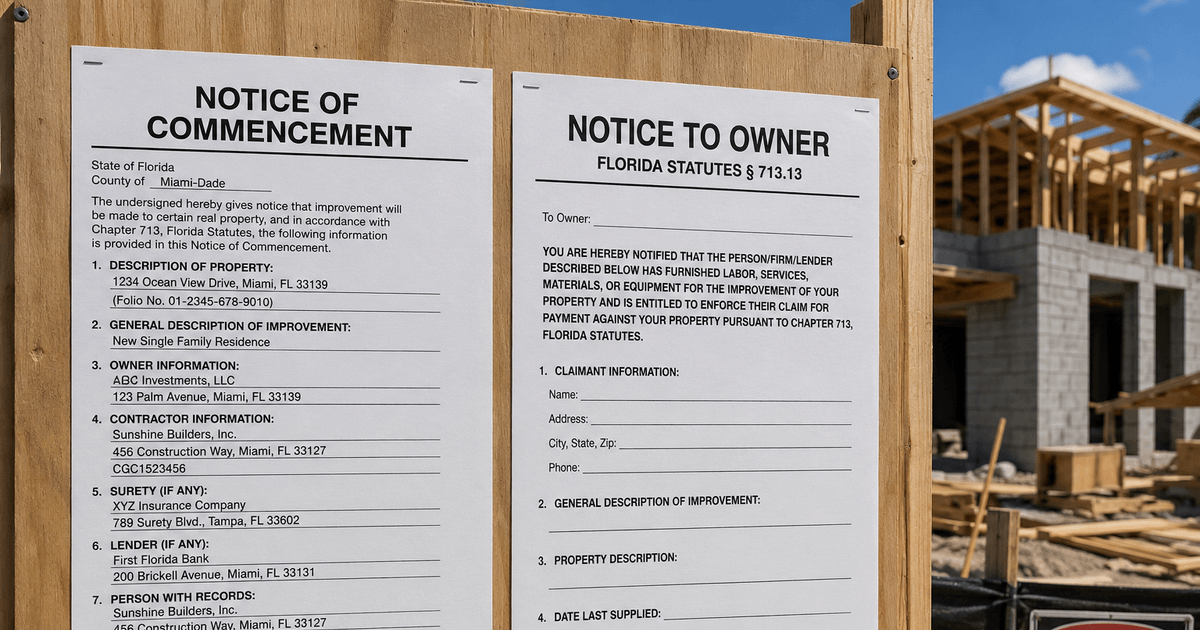
A Notice of Commencement, often called an NOC, is a recorded construction document that announces that an improvement is being made to real property in Florida.
Under Florida law, the Notice of Commencement must include several categories of information, including:
- A legal description, street address, and tax folio number if available;
- A general description of the improvement;
- The owner's name and address;
- The owner's interest in the property;
- The fee simple titleholder's name and address, if different from the owner;
- The contractor's name and address;
- The surety's name, address, and bond amount, if there is a payment bond;
- The lender's name and address, if construction financing is involved; and
- The name and Florida address of any person designated by the owner to receive notices. (Fla. Stat. § 713.13.)
The statute also provides a form Notice of Commencement and includes a prominent warning to owners that payments made after the Notice of Commencement expires are considered improper payments and may result in the owner paying twice for the same improvement. (Fla. Stat. § 713.13.)
In plain English, the Notice of Commencement is the project's public starting point. It identifies the project, the owner, the contractor, the lender, the surety if any, and the place where statutory notices should go.
Who Needs a Notice of Commencement?
Property Owners
The owner is usually the person responsible for ensuring the Notice of Commencement is recorded and posted. Florida law states that, except for exempt improvements, an owner or the owner's authorized agent must record the notice before actually commencing the improvement. (Fla. Stat. § 713.13.)
Owners should care because Florida's lien system can expose real property to claims by unpaid contractors, subcontractors, sub-subcontractors, material suppliers, and certain laborers. A properly recorded and posted Notice of Commencement helps organize the project's notice chain and supports proper payment practices.
Contractors
The contractor is listed in the Notice of Commencement. For contractors, the NOC helps establish the official project record and identifies parties such as the owner, lender, and surety. Contractors also have important obligations later in the process, including the contractor's final payment affidavit before enforcing lien rights in many circumstances. (Fla. Stat. § 713.06.)
Subcontractors and Suppliers
Subcontractors, sub-subcontractors, and material suppliers often depend on the Notice of Commencement because it identifies where their Notice to Owner should be sent. Under Florida law, lienors not in privity with the owner generally must serve a Notice to Owner before commencing work or not later than 45 days after first furnishing labor, services, or materials. Failure to timely serve that notice is a complete defense to enforcement of the lien. (Fla. Stat. § 713.06.) We cover that deadline in depth in Florida's 45-Day Notice to Owner.
Lenders
Construction lenders also appear in the Notice of Commencement. Florida law provides that a lender must, before disbursing construction funds to the contractor, record the Notice of Commencement in the clerk's office when required by the statute. The lender is not required to post the notice at the job site; posting remains the owner's obligation. (Fla. Stat. § 713.13.)
Building Departments and Permit Authorities
Florida's permitting statute requires issuing authorities to provide owners and applicants with information about construction lien law and forms for the Notice of Commencement. For direct contracts greater than $5,000, the applicant must file a copy of the Notice of Commencement with the issuing authority before the first inspection, subject to statutory exceptions. (Fla. Stat. § 713.135.)
When Must a Notice of Commencement Be Recorded?
The Notice of Commencement should be recorded before actually commencing the improvement. Florida law also requires posting either a certified copy of the recorded notice or a notarized statement that the notice has been filed for recording along with a copy. (Fla. Stat. § 713.13.)
For permitting purposes, a Notice of Commencement generally does not have to be recorded before a building permit is issued. However, if the direct contract is greater than $5,000, the applicant must file a copy of the Notice of Commencement before the first inspection. If that copy is not filed, the issuing authority or private inspection provider may not perform or approve later inspections until the copy is filed. (Fla. Stat. § 713.135.)
There is also an important timing rule after recordation: if the improvement described in the Notice of Commencement is not actually commenced within 90 days after recording, the notice becomes void and has no further effect. (Fla. Stat. § 713.13.)
How Long Does a Florida Notice of Commencement Last?
Unless the notice says otherwise, a Notice of Commencement generally expires one year after recording. If the contract between the owner and the contractor states a completion period longer than one year, the Notice of Commencement must state that it is effective for one year plus the additional period. Payments made after expiration are considered improper payments. (Fla. Stat. § 713.13.)
This expiration rule matters because Florida lien law is built around proper notices and proper payments. If an owner continues paying after the Notice of Commencement has expired, those payments may create avoidable risk.
Why Does the Notice of Commencement Matter?
The Notice of Commencement matters because it connects the start of work to Florida's mechanic lien framework.
It Creates a Public Project Record
A recorded Notice of Commencement gives constructive notice that claims of lien may be recorded and may take priority as provided by Florida's lien-priority statute. Importantly, the recording of a Notice of Commencement does not itself constitute a lien, cloud, or encumbrance on the property. (Fla. Stat. § 713.13.)
It Helps Lienors Serve the Right People
The Notice of Commencement identifies the owner, contractor, lender, surety, and any designated person for service of notices. That is critical because many lienors who do not have a direct contract with the owner must serve a Notice to Owner as a prerequisite to perfecting a lien. (Fla. Stat. § 713.06.) The specifics of that service requirement are covered on our Florida Notice Requirements page.
It Helps Owners Avoid Paying Twice
Florida's statutory forms warn owners that unpaid subcontractors and suppliers may be able to lien the property even if the owner already paid the general contractor. The Notice to Owner form expressly warns that Florida's construction lien law allows some unpaid contractors, subcontractors, and material suppliers to file liens against the property even if the owner has paid in full. (Fla. Stat. § 713.06.)
That is why owners should track every Notice to Owner received, require partial lien releases with progress payments, require a contractor's final payment affidavit before final payment, and confirm that all lienors who gave notice are properly paid or released.
What Is a Mechanic's Lien in Florida?
A mechanic's lien, called a construction lien in Florida's statute, is a legal claim against improved real property for unpaid labor, services, or materials furnished to the project.
Under Florida law, certain subcontractors, sub-subcontractors, material suppliers, and laborers who are not in privity with the owner may have a lien on the improved real property if they comply with Chapter 713. The total amount of all liens under a direct contract generally may not exceed the contract price fixed by that direct contract, subject to statutory exceptions. (Fla. Stat. § 713.06.)
To perfect a construction lien, a lienor must record a Claim of Lien that includes required information such as the lienor's name and address, the person with whom the lienor contracted, the labor or materials furnished, a property description, the owner's name, the first and last dates of furnishing, the unpaid amount, and, for lienors not in privity with the owner, the date and method of service of the Notice to Owner. (Fla. Stat. § 713.08.)
How the Notice of Commencement and Mechanic's Liens Work Together
The relationship between a Notice of Commencement and a mechanic's lien is best understood as a sequence:
- The owner records and posts the Notice of Commencement. This identifies the project, property, owner, contractor, lender, surety, and notice recipients.
- Subcontractors and suppliers use that information to serve Notices to Owner. Most lienors not in direct contract with the owner must serve the Notice to Owner before starting or within 45 days after first furnishing labor, services, or materials. (Fla. Stat. § 713.06.)
- The owner uses Notices to Owner to make proper payments. Once an owner receives Notices to Owner, the owner should ensure those noticed lienors are paid or provide releases before funds are disbursed.
- If a lienor remains unpaid, the lienor may record a Claim of Lien. A Claim of Lien may be recorded during the work or after the work, but generally no later than 90 days after the lienor's final furnishing of labor, services, or materials. (Fla. Stat. § 713.08.)
- The lien may affect title and payment leverage. Unlike the Notice of Commencement, a recorded Claim of Lien is a legal document stating that a construction lien has been placed on the property. Florida's statutory form warns that, unless shortened, the lien may remain valid for one year from recording unless legal proceedings are commenced to foreclose or discharge it. (Fla. Stat. § 713.08.)
In short: the Notice of Commencement starts the notice framework; the Notice to Owner preserves many lienors' rights; and the Claim of Lien is the recorded claim against the property if payment is not made.
Notice of Commencement vs. Notice to Owner vs. Claim of Lien
| Document | Who typically uses it? | What it does | Is it a lien? |
|---|---|---|---|
| Notice of Commencement | Owner and owner's agent; lender obligations are sometimes involved | Publicly identifies the project and key parties before work begins | No. The statute says recording it does not constitute a lien, cloud, or encumbrance. (§ 713.13.) |
| Notice to Owner | Lienors not in privity with the owner, except certain laborers | Alerts the owner that the sender is furnishing labor, services, or materials and may have lien rights | No. The statute says the notice is not a lien, cloud, or encumbrance. (§ 713.06.) |
| Claim of Lien | Unpaid lienors seeking to perfect lien rights | Records the lien claim against the property | Yes. It is the recorded construction lien document. (§ 713.08.) |
Common Mistakes to Avoid
Mistake 1: Treating the Notice of Commencement Like a Lien
A Notice of Commencement is not a mechanic's lien. It is a recorded notice that a project is beginning. Florida law expressly says it does not constitute a lien, cloud, or encumbrance on the property. (Fla. Stat. § 713.13.)
Mistake 2: Recording Too Early and Then Delaying the Project
If the work described in the Notice of Commencement does not actually begin within 90 days after recording, the notice is void and has no further effect. Owners and contractors should coordinate recording with the actual start of work. (Fla. Stat. § 713.13.)
Mistake 3: Ignoring the 45-Day Notice to Owner Deadline
For most lienors not in privity with the owner, the Notice to Owner must be served before commencing or within 45 days after commencing to furnish labor, services, or materials. Florida law states that failure to serve the notice, or failure to timely serve it, is a complete defense to lien enforcement by that person. (Fla. Stat. § 713.06.)
Mistake 4: Missing the 90-Day Claim of Lien Deadline
A Claim of Lien generally must be recorded no later than 90 days after the lienor's final furnishing of labor, services, or materials. Missing this deadline can be fatal to lien rights. (Fla. Stat. § 713.08.)
Mistake 5: Making Final Payment Without Managing Releases
Owners should not treat payment to the general contractor as the end of the story. Florida's Notice to Owner warning exists because unpaid subcontractors and suppliers may have lien rights even when the owner has paid the contractor. Owners should collect releases and review the contractor's final payment affidavit before final payment. (Fla. Stat. § 713.06.)
Practical Checklist for Florida Property Owners
Before construction starts:
- Confirm whether the project requires a Notice of Commencement.
- Record the Notice of Commencement in the county clerk's official records.
- Post the required copy or notarized filing statement at the job site.
- Confirm the Notice of Commencement lists the correct owner, contractor, lender, surety, legal description, and project description.
- If the project is financed, coordinate with the lender before recording and before work begins.
During construction:
- Keep a file of every Notice to Owner received.
- Do not ignore suppliers or subcontractors who send notices.
- Require partial releases when progress payments are made.
- Track whether the Notice of Commencement is approaching expiration.
Before final payment:
- Obtain the contractor's final payment affidavit when required.
- Confirm all noticed lienors have been paid or have provided releases.
- Consider title, lien, and legal review before releasing final funds.
Practical Checklist for Subcontractors and Suppliers
- Locate the recorded Notice of Commencement as early as possible.
- Confirm the owner, contractor, lender, surety, and designated recipients.
- Serve the Notice to Owner before starting or within 45 days after first furnishing labor, services, or materials.
- Calendar the 90-day deadline from final furnishing to record any Claim of Lien.
- Serve the Claim of Lien on the owner before recording or within 15 days after recording to avoid prejudice-based challenges. (Fla. Stat. § 713.08.)
The Bottom Line
The Notice of Commencement is the gateway document for many Florida construction projects. It does not create a lien, but it helps define the project, identify the parties, and direct the notices that make Florida's mechanic lien system work.
For owners, the Notice of Commencement is part of a payment-protection strategy. For contractors, it helps organize the project record. For subcontractors and suppliers, it provides the information needed to serve timely notices and preserve lien rights. And for everyone involved, it is a reminder that Florida construction lien law is technical, deadline-driven, and unforgiving when key notices are missed.
If you are a contractor, subcontractor, or supplier trying to protect a Florida receivable — or an owner trying to avoid paying twice — National Lien & Bond can help you serve the right notices on time. Review the full Florida mechanic lien guide, check the Florida notice requirements, or request a free consultation.
Frequently Asked Questions
Is a Notice of Commencement the same as a mechanic's lien in Florida?
No. A Notice of Commencement is a recorded notice that a construction project is beginning and who the key parties are. Florida law expressly states that recording a Notice of Commencement does not constitute a lien, cloud, or encumbrance on the property (Fla. Stat. § 713.13). A mechanic's lien — called a Claim of Lien in Florida — is a separate recorded document under § 713.08 that places an actual claim against the property for unpaid work.
Who is responsible for recording the Notice of Commencement?
The property owner or the owner's authorized agent is generally responsible for recording the Notice of Commencement before improvements begin, and for posting a certified copy (or a notarized statement that it has been filed) at the job site (Fla. Stat. § 713.13). On financed projects, the construction lender must record the notice before disbursing funds when the statute requires it, but posting at the job site remains the owner's obligation.
How long does a Florida Notice of Commencement last?
Unless the notice states otherwise, a Notice of Commencement generally expires one year after it is recorded. If the owner-contractor agreement specifies a completion period longer than one year, the notice must state that it is effective for one year plus that additional period (Fla. Stat. § 713.13). Payments made after the notice expires are treated as improper payments and can expose the owner to paying twice.
What happens if work doesn't start within 90 days of recording the Notice of Commencement?
If the improvement described in the Notice of Commencement is not actually commenced within 90 days after recording, the notice becomes void and has no further effect (Fla. Stat. § 713.13). Owners and contractors should coordinate recording the notice with the actual start of work so it does not lapse.
Why do subcontractors and suppliers care about the Notice of Commencement?
The Notice of Commencement identifies the owner, contractor, lender, surety, and any person designated to receive notices. Lienors not in privity with the owner generally must serve a Notice to Owner before starting or within 45 days of first furnishing labor, services, or materials, and failing to do so is a complete defense to their lien (Fla. Stat. § 713.06). The Notice of Commencement tells them exactly who must receive that notice.
Does recording a Notice of Commencement put a lien on my property?
No. Recording a Notice of Commencement does not place any lien, cloud, or encumbrance on your property (Fla. Stat. § 713.13). It is an informational record that organizes the project's notice chain. A lien only arises if an unpaid lienor later records a Claim of Lien under § 713.08.
Sources
- 1.Fla. Stat. § 713.13 — Notice of Commencement
- 2.Fla. Stat. § 713.135 — Notice of Commencement and Applicability of Lien (permitting)
- 3.Fla. Stat. § 713.06 — Liens of Persons Not in Privity; Proper Payments
- 4.Fla. Stat. § 713.08 — Claim of Lien
- 5.Fla. Stat. § 713.01 — Definitions
- 6.Fla. Stat. § 713.18 — Manner of Serving Notices and Other Instruments
- 7.The Florida Bar — Construction Law Section: Construction Lien Practice Resources
Related Articles
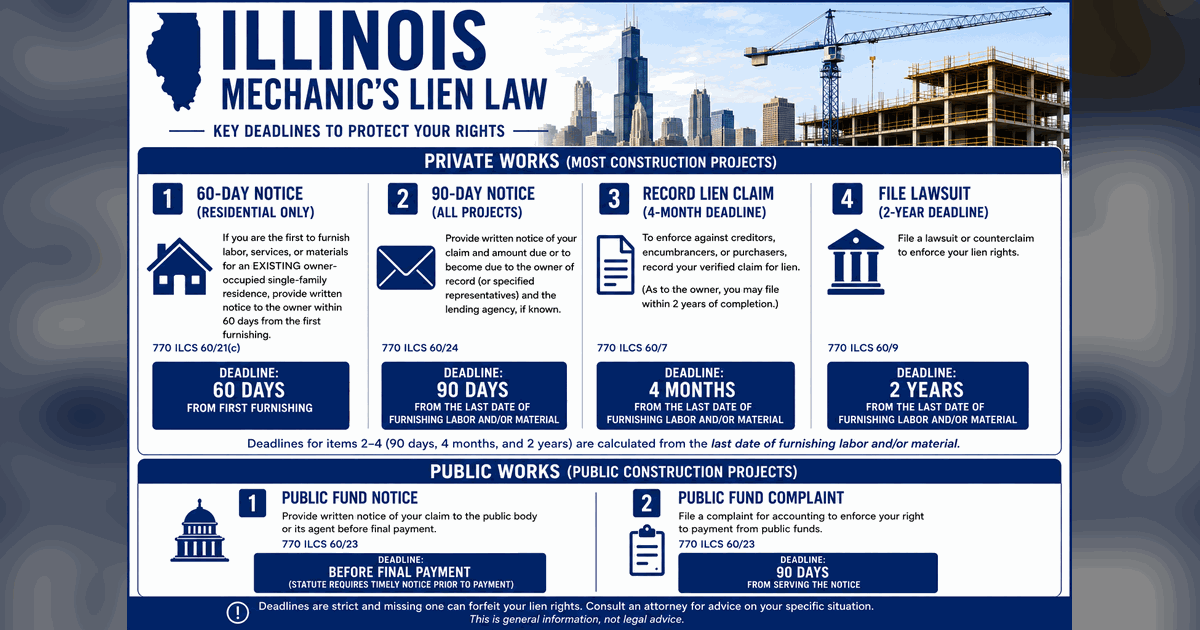
How an Illinois Subcontractor Protects the Right to Get Paid: The 90-Day Notice, the 4-Month Recording Deadline, and the 2-Year Suit Window
Illinois subcontractors and suppliers protect payment rights by serving the 90-day notice, recording within 4 months to protect priority, and filing suit within 2 years. This guide explains the deadlines, residential traps, trust-fund issues, and public-works alternatives.
Read Article
How a Colorado Subcontractor Protects the Right to Get Paid: The Notice of Intent, the 4-Month Lien Deadline, and the 6-Month Suit Window
Colorado subcontractors and suppliers usually protect payment rights by serving a Notice of Intent, recording a lien within 4 months, and filing suit within 6 months. Here is how the deadlines work, what commonly goes wrong, and how public-works bond claims differ.
Read Article
The Miller Act Deadlines That Decide Whether You Get Paid on a Federal Project
You cannot lien a federal courthouse, an Army base, or a VA hospital. On a federal construction project the payment bond is your security, and two Miller Act deadlines decide whether you collect: a 90-day notice and a one-year suit window.
Read Article