
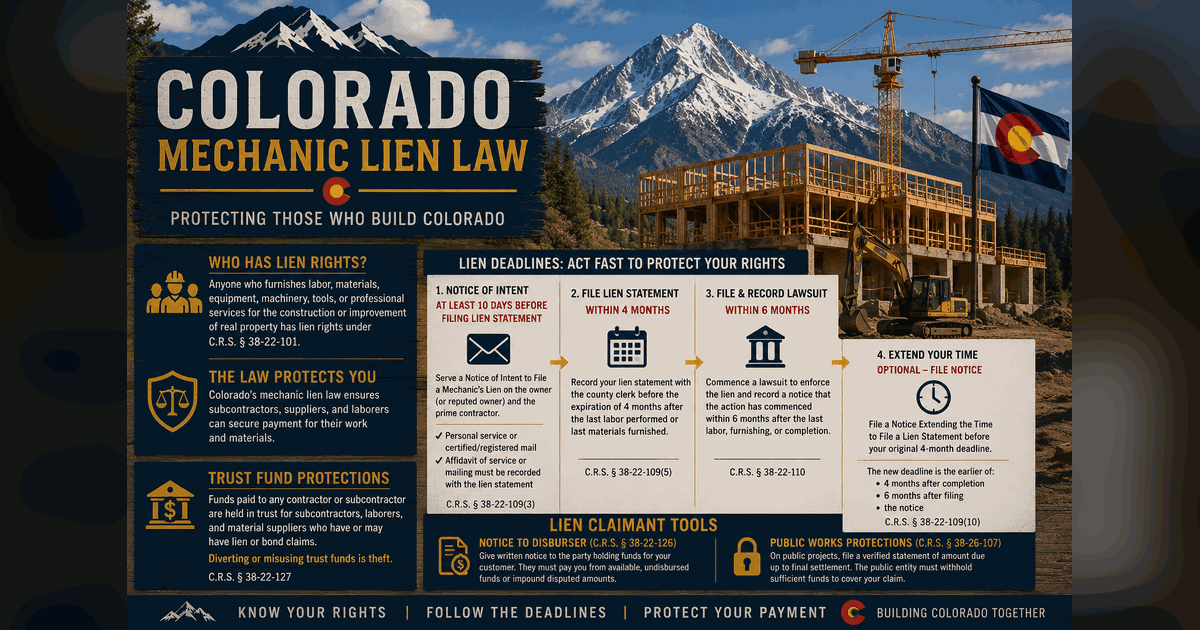
How a Colorado Subcontractor Protects the Right to Get Paid: The Notice of Intent, the 4-Month Lien Deadline, and the 6-Month Suit Window
You finished your scope. The general contractor says payment is coming. The owner says the draw has not cleared. The project manager wants one more invoice copy. Meanwhile, your Colorado lien rights are running on a calendar that does not care about promises, pay apps, or "we'll get you next week."
For a Colorado subcontractor or material supplier, the right to get paid often lives or dies on a few dates: when you last furnished labor or materials, when you served the Notice of Intent, when you recorded the lien statement, and whether you filed suit in time. Colorado's private mechanic's lien statute, C.R.S. § 38-22-101 et seq., gives powerful leverage, but only if you follow the statutory steps.
This guide is educational, not legal advice. It does not create an attorney-client relationship. But it reflects what we see in practice when unpaid subs and suppliers wait too long, serve the wrong party, or assume settlement discussions have stopped the clock.
Who Has Lien Rights in Colorado — and Who Doesn't
Colorado mechanic's lien rights are broad, but not unlimited. C.R.S. § 38-22-101 gives lien rights to contractors, subcontractors, materialmen, laborers, equipment suppliers, and certain design professionals who furnish labor, laborers, materials, machinery, tools, equipment, or services for construction, alteration, improvement, addition, or repair of real property.
For a typical unpaid subcontractor, the key point is this: you do not need a direct contract with the owner to have lien rights. Colorado treats the contractor, subcontractor, builder, architect, engineer, or other person in charge of the work as the owner's agent for mechanic's lien purposes under C.R.S. § 38-22-101(1). That is why a subcontractor who contracted with the general contractor, or a supplier who supplied a subcontractor, may often lien the improved property.
But Colorado does draw a line at remote suppliers. A supplier to a supplier — often called a sub-materialman — generally does not have lien rights. The Colorado Supreme Court's reasoning in Western Metal Lath v. Acoustical & Construction Supply, Inc., 851 P.2d 875 (Colo. 1993), confirms the tier problem: the law protects those with a direct relationship to the contractor or subcontractor chain, but not a supplier to a materialman. In practice, this is one of the first questions we ask: who did you contract with, and what did that party actually do on the project?
If you are a supplier, do not assume that "my material went into the building" is enough. In Colorado, your contracting tier matters.
The Notice of Intent: Who, What, When, and How
Colorado does not let you simply record a lien statement without warning. To preserve a private mechanic's lien, C.R.S. § 38-22-109(3) requires a Notice of Intent to File Lien Statement.
The Notice of Intent must be served on the owner or reputed owner of the property, or the owner's agent; and the principal or prime contractor, or that contractor's agent.
The timing is strict: the Notice of Intent must be served at least 10 days before the lien statement is recorded. In practice, do not treat this as "about ten days." Give yourself a cushion. If the lien deadline is close, the notice timing must be calculated carefully so you do not run out of recording time while waiting out the notice period.
The statute allows service by personal service or by registered or certified mail, return receipt requested, addressed to the last-known address of the required recipients. Colorado appellate decisions are helpful on one point: if the notice is properly sent by certified or registered mail, courts have treated the mailing as the operative event rather than requiring proof of actual receipt. See Weyerhauser Co. (Everitt Lumber Div.) v. Colorado Quality Research, Inc., 778 P.2d 290 (Colo. App. 1989), and 6S Corp. v. Martinez, 831 P.2d 509 (Colo. App. 1992).
But do not mistake that rule for flexibility on the paperwork. C.R.S. § 38-22-109(3) also requires an affidavit of service or mailing to be recorded with the lien statement. In Everitt Lumber Co. v. Prudential Insurance Co. of America, 660 P.2d 925 (Colo. App. 1983), the claimant had actual notice to the principal contractor but failed to record the required affidavit of service on the principal contractor. The court held the lien unenforceable. That is a real-world trap: actual notice may not save a defective lien package.
When we file these claims, we treat the notice packet and recording packet as one system: correct parties, correct addresses, proof of mailing or service, the full 10-day waiting period, and the affidavit recorded with the lien statement.
The 4-Month Lien Statement Deadline
For most Colorado subcontractors and material suppliers on private projects, the lien statement must be recorded within 4 months after the last day labor was performed or the last laborers or materials were furnished by that claimant. That rule comes from C.R.S. § 38-22-109(5).
This is not the same as four months after your invoice date. It is not four months after the pay application was rejected. It is not four months after the general contractor stopped answering emails. The usual date is tied to your last actual furnishing of labor, laborers, or materials for the project.
The lien statement itself must include the information required by C.R.S. § 38-22-109(1): the owner or reputed owner, the claimant, the party who furnished the laborers or materials or performed the labor, the contractor when the claimant is a subcontractor, a property description sufficient to identify the property, and the amount due or owing. It must be signed and sworn under C.R.S. § 38-22-109(2).
There are important variations.
Laborers who perform labor by the day or piece, without furnishing laborers or materials, have a shorter recording window. C.R.S. § 38-22-109(4) gives those labor claimants 2 months after completion of the building, structure, or improvement.
Single- or double-family dwellings sold to a bona fide purchaser require special caution. C.R.S. § 38-22-125 provides that, with limited exceptions, a lien filed more than 2 months after completion will not encumber the bona fide purchaser's interest unless the purchaser had actual knowledge, the lien was recorded before conveyance, or a qualifying notice under C.R.S. § 38-22-109(10) was timely filed. This is narrower than saying "all residential liens are due in two months," but for a subcontractor on a house that may be sold, it is dangerous to rely on the ordinary four-month period without reviewing the facts.
Punch-list or remedial work usually should not be used to restart the clock. C.R.S. § 38-22-109(7) states that trivial imperfections or omissions do not postpone lien deadlines. In Kehn v. Spring Creek Village I, 563 P.2d 969 (Colo. App. 1977), the court applied the trivial-imperfection rule to all lien claimants and focused on whether later work was trivial and whether the project was complete. The practical lesson is simple: do not assume a warranty visit, attempted fix, or minor follow-up delivery gives you a new lien deadline.
A Notice of Extension is available under C.R.S. § 38-22-109(10). If timely filed, that notice can extend the time to record the mechanic's lien statement to the earlier of 4 months after completion of the structure or improvement, or 6 months after recording the notice. This can be useful on longer projects where your furnishing date is early but the overall improvement is still ongoing. It is not a substitute for monitoring the lien deadline.
The 6-Month Suit-to-Enforce Window
Recording the lien is not the end of the process. A recorded lien creates leverage, but it does not last indefinitely.
Under C.R.S. § 38-22-110, a Colorado mechanic's lien generally will not hold the property longer than 6 months after the last work or labor is performed, laborers or materials are furnished, or completion of the improvement, as prescribed in C.R.S. § 38-22-109, unless an action is commenced within that time to enforce the lien. The claimant must also record a notice that the enforcement action has been commenced within that same time.
This is the deadline that often gets missed during settlement talks. The owner may be negotiating. The general contractor may be promising a joint-check agreement. The lender may be asking for a payoff figure. None of that automatically extends the statutory suit deadline.
If your lien has been recorded and the six-month enforcement window is approaching, you need a litigation decision before the deadline expires. Once the enforcement window is gone, the lien leverage can be gone with it.
The Trust Fund Statute as a Second Avenue of Recovery
Colorado also has a construction trust fund statute. C.R.S. § 38-22-127(1) provides that funds disbursed to any contractor or subcontractor under a building, construction, or remodeling contract, or on a construction project, are held in trust for the payment of subcontractors, laborers, and material suppliers who have or may have lien or bond claims for which the disbursement was made.
This can matter when the money was paid downstream but never reached you. If an owner paid the general contractor for your work, or the general contractor paid a subcontractor for materials you supplied, those funds may carry trust obligations.
The statute has teeth. C.R.S. § 38-22-127(5) says a violation of the trust-fund duties constitutes theft under Colorado law. That means trust-fund issues can create personal and even criminal exposure in the right case. We do not lead with threats, but when payment funds were diverted, the trust fund statute can change the conversation.
The Colorado Supreme Court's decision in In re Regan, 151 P.3d 1281 (Colo. 2007), is important. The court held that the lien-perfection procedures in C.R.S. §§ 38-22-109 and 38-22-110 do not apply to trust-fund claims under C.R.S. § 38-22-127. In other words, the trust-fund remedy is related to mechanic's lien rights but separate from the lien-recording process.
That does not mean every unpaid invoice is automatically a trust-fund claim. The facts still matter: who was paid, for what work, what funds were disbursed, whether there is a good-faith dispute or setoff, and whether records show project funds were misapplied.
A Short Public-Works Contrast: Bond Claim, No Lien on Public Property
If your project is public, the rules change. You generally cannot lien public property. Colorado's public-works statutes, C.R.S. § 38-26-101 et seq., provide different remedies because the courthouse, school, road, or municipal facility cannot be sold through a mechanic's lien foreclosure.
On many public projects, the payment remedy is a bond or retained public funds. C.R.S. § 38-26-106 requires a bond or acceptable surety before performance begins on covered public works contracts. The threshold is not the same for every public owner: local-government public works contracts are covered when they exceed $50,000, while state public works contracts and certain public-property/private-entity contracts use $150,000 thresholds.
C.R.S. § 38-26-107 also allows an unpaid claimant to file a verified statement of the amount due with the public body up to and including final settlement. Once a proper claim is filed, the public body must withhold sufficient funds to ensure payment until the claim is paid, withdrawn, or litigated. The statute provides that retained funds are not withheld longer than 90 days after the final settlement date unless an action is commenced and the required notice is filed.
If you are unpaid on a public project, do not prepare a private mechanic's lien and hope it works. Identify the public owner, request the bond, track final settlement, and preserve the bond or fund claim on the correct timeline.
Disburser Notices: Useful, but Easy to Misunderstand
Colorado also has disburser notice rights under C.R.S. § 38-22-126. A "disburser" may be a lender, owner, contractor, or other person who controls construction funds as work progresses.
The important claimant-side tool is the notice described in C.R.S. § 38-22-126(4). A lien claimant may give written notice to the disburser identifying the property, the claimant, the person with whom the claimant contracted, and a general statement of the contract. Once the disburser receives that notice, C.R.S. § 38-22-126(6) requires the disburser, before disbursing funds to the person with whom the claimant contracted, to ascertain the amount due and pay the claimant directly from available undisbursed funds due to that person. If the amount is disputed, the disburser may impound the disputed amount.
In practice, claimants sometimes confuse a notice that has legal effect with a generic "Disburser's Notice" recorded by the lender or owner. The claimant's Notice to Disburse Direct is the tool that can force attention to unpaid amounts before remaining funds leave the project.
Common Failure Modes
Counting from the invoice date instead of last furnishing. The four-month clock usually runs from last labor or last furnishing of materials, not from the date you finally billed the job.
Relying on punch-list work to revive a deadline. Trivial or remedial work generally does not postpone the lien deadline. If the later work is minor, do not count on it.
Serving only the owner or only the general contractor. C.R.S. § 38-22-109(3) requires service on both the owner or reputed owner and the principal or prime contractor, or their agents.
Skipping the affidavit of service or mailing. The affidavit must be recorded with the lien statement. Everitt Lumber shows that actual notice may not save a lien if the statutory affidavit requirement was not met.
Assuming every supplier has lien rights. A supplier to a supplier may be outside Colorado lien protection. Confirm your tier before spending time and money on a lien strategy.
Letting settlement talks run out the suit deadline. A recorded lien still needs timely enforcement. If the six-month window is about to expire, negotiations do not automatically protect you.
Action Checklist for Colorado Subcontractors
- Identify whether the project is private or public.
- Confirm your contracting tier: owner, general contractor, subcontractor, or supplier.
- Determine your last actual furnishing date.
- Calendar the ordinary 4-month lien recording deadline and any shorter residential or laborer issue.
- Serve the Notice of Intent on the owner and prime contractor at least 10 full days before recording.
- Use personal service or registered/certified mail, return receipt requested.
- Prepare and record the affidavit of service or mailing with the lien statement.
- Record the lien statement in the county where the property is located.
- Calendar the 6-month enforcement deadline immediately after recording.
- Consider whether a trust-fund demand, Notice to Disburse Direct, or bond claim should be pursued at the same time.
- If the project is public, request the bond and track final settlement instead of preparing a private-property lien.
Colorado lien law rewards speed and precision. If you are unpaid, the safest move is to calculate the deadlines early, before the last week, and have the notice, lien statement, affidavits, and enforcement calendar reviewed together.
National Lien & Bond helps contractors, subcontractors, and suppliers evaluate lien and bond deadlines nationwide. If you are looking at an unpaid Colorado project, you can ask us to review your dates and documents before the window closes. No article can guarantee an outcome or replace advice on your specific facts, but a prompt deadline review can often prevent avoidable mistakes.
Frequently Asked Questions
Do Colorado subcontractors need to send a Notice of Intent before filing a mechanic's lien?
Yes. For a private mechanic's lien, C.R.S. § 38-22-109(3) requires a Notice of Intent to File Lien Statement to be served on the owner or reputed owner and the principal or prime contractor at least 10 days before the lien statement is recorded.
What is the main Colorado mechanic's lien deadline for subcontractors and suppliers?
For most subcontractors and material suppliers, the lien statement must be recorded within 4 months after the last labor was performed or the last laborers or materials were furnished by that claimant under C.R.S. § 38-22-109(5).
Does punch-list or warranty work extend the Colorado lien deadline?
Do not assume it does. C.R.S. § 38-22-109(7) says trivial imperfections or omissions do not postpone lien deadlines, and Kehn v. Spring Creek Village I confirms that later work may not extend the deadline if it is merely trivial or the project was already complete.
How long do you have to sue to enforce a Colorado mechanic's lien?
C.R.S. § 38-22-110 generally requires the enforcement action, and a recorded notice that the action has commenced, within 6 months after the relevant last work, furnishing, or completion date. Recordation alone is not enough.
Can you lien public property in Colorado?
No, public property is generally not subject to a private mechanic's lien foreclosure. On Colorado public works, unpaid claimants usually look to the payment bond and the verified statement / retained-funds procedure under C.R.S. § 38-26-107.
Sources
- 1.C.R.S. § 38-22-101 — Liens in favor of whom; private mechanic's lien entitlement.
- 2.C.R.S. § 38-22-109 — Notice of Intent; lien statement contents; recording deadlines; trivial-imperfection rule; Notice of Extension.
- 3.C.R.S. § 38-22-110 — Action to enforce mechanic's lien within six months and recorded notice of action.
- 4.C.R.S. § 38-22-125 — Bona fide purchaser rule for single- or double-family dwellings.
- 5.C.R.S. § 38-22-126 — Disburser notice and direct-payment duties.
- 6.C.R.S. § 38-22-127 — Construction trust fund statute and theft penalty.
- 7.C.R.S. § 38-26-101 — Public-works contractor definition.
- 8.C.R.S. § 38-26-106 — Public-works bond / acceptable surety requirements and thresholds.
- 9.C.R.S. § 38-26-107 — Verified statement of amount due; withholding funds; final-settlement procedure.
- 10.Kehn v. Spring Creek Village I, 563 P.2d 969 (Colo. App. 1977).
- 11.Everitt Lumber Co. v. Prudential Insurance Co. of America, 660 P.2d 925 (Colo. App. 1983).
- 12.Weyerhauser Co. (Everitt Lumber Div.) v. Colorado Quality Research, Inc., 778 P.2d 290 (Colo. App. 1989).
- 13.6S Corp. v. Martinez, 831 P.2d 509 (Colo. App. 1992).
- 14.Western Metal Lath v. Acoustical & Construction Supply, Inc., 851 P.2d 875 (Colo. 1993).
- 15.In re Regan, 151 P.3d 1281 (Colo. 2007).
Related Articles
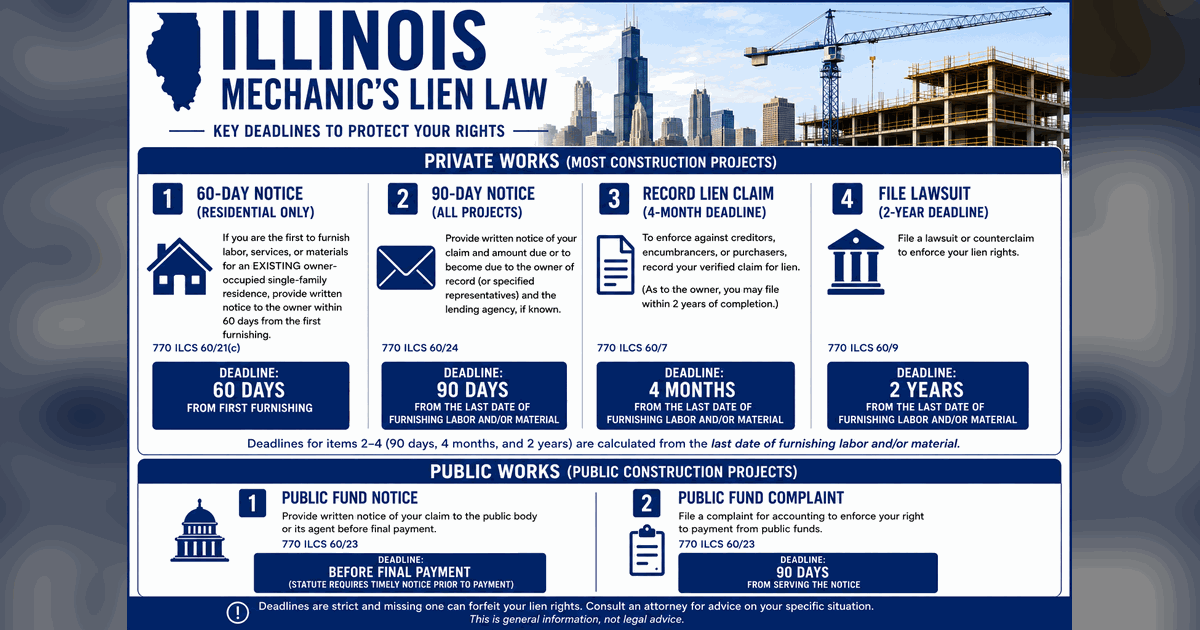
How an Illinois Subcontractor Protects the Right to Get Paid: The 90-Day Notice, the 4-Month Recording Deadline, and the 2-Year Suit Window
Illinois subcontractors and suppliers protect payment rights by serving the 90-day notice, recording within 4 months to protect priority, and filing suit within 2 years. This guide explains the deadlines, residential traps, trust-fund issues, and public-works alternatives.
Read Article
The Miller Act Deadlines That Decide Whether You Get Paid on a Federal Project
You cannot lien a federal courthouse, an Army base, or a VA hospital. On a federal construction project the payment bond is your security, and two Miller Act deadlines decide whether you collect: a 90-day notice and a one-year suit window.
Read Article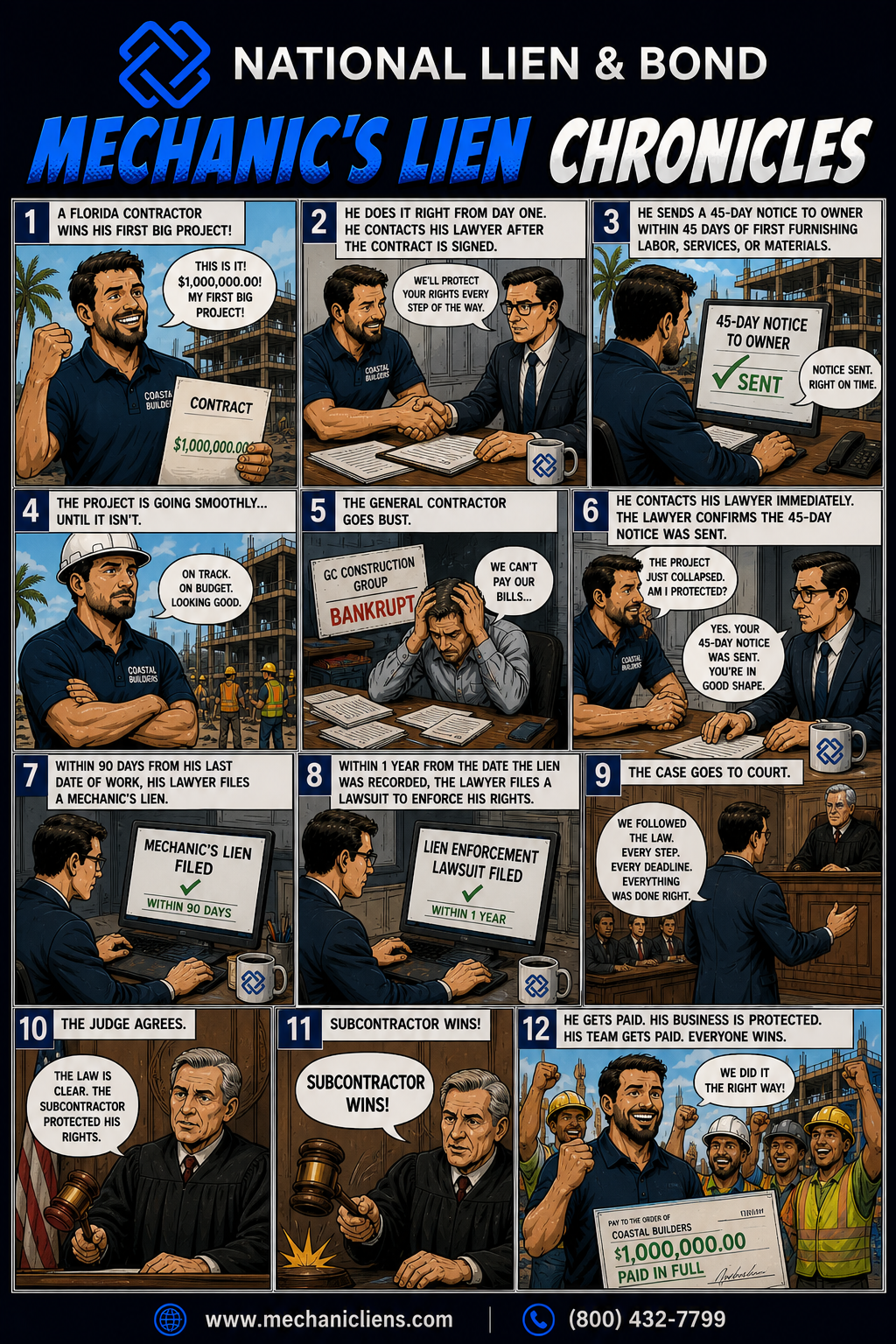
Florida's 45-Day Notice to Owner: The Line Between Getting Paid and Closing Your Doors
On a Florida private commercial project, missing the 45-day Notice to Owner deadline destroys your lien rights — and the attorney-fee clause in your subcontract will not save you. A side-by-side story of one missed step worth a million dollars.
Read Article