
Florida's 45-Day Notice to Owner: The Line Between Getting Paid and Closing Your Doors
The 45 Days That Decide Everything
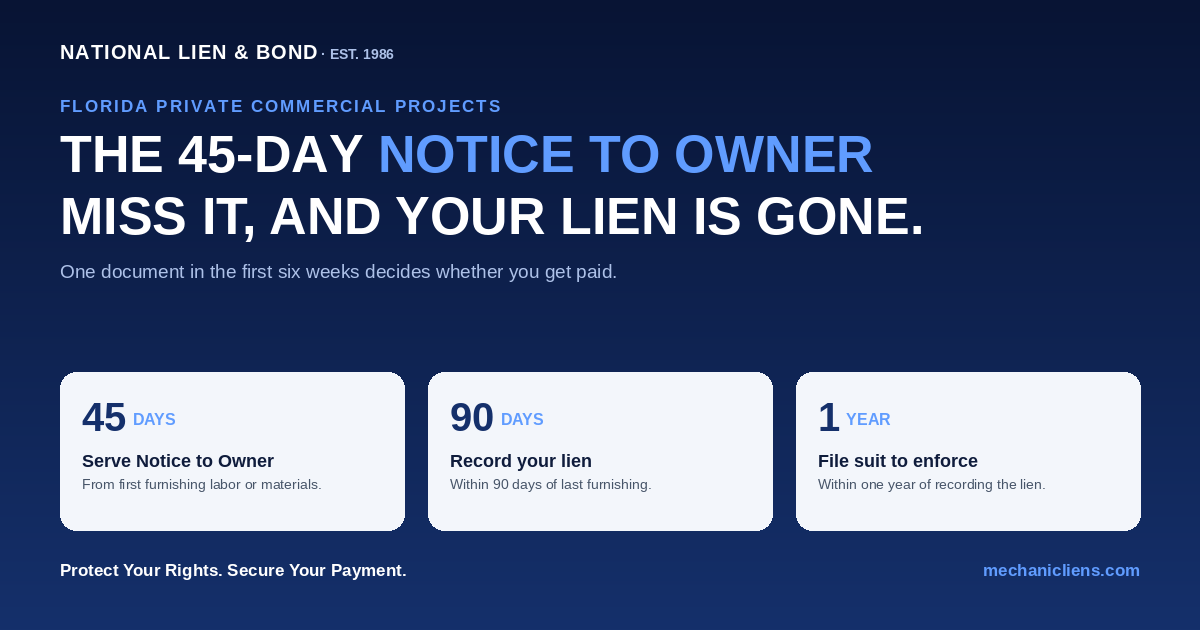
On a Florida private commercial project, the difference between collecting on a million-dollar invoice and shuttering your business often comes down to a single document served in the first 45 days of work. The document is the Notice to Owner under section 713.06, Florida Statutes. The deadline is 45 days from your first furnishing of labor, services, or materials to the job. Miss it, and your lien is unenforceable as a matter of law no matter how strong your subcontract is, no matter how well documented your invoices are, and no matter how plainly you have been wronged.
This is not abstract. Florida lien practice is dominated by claims that fail not because the work was bad or the contract was weak, but because a procedural notice required at the front of the project was either never served or served a few days late. The two stories below — one right, one wrong — show how the same project, the same general contractor, and the same bankruptcy filing produce two completely different outcomes depending on a piece of paper sent in the first six weeks.
Story One — The Right Way
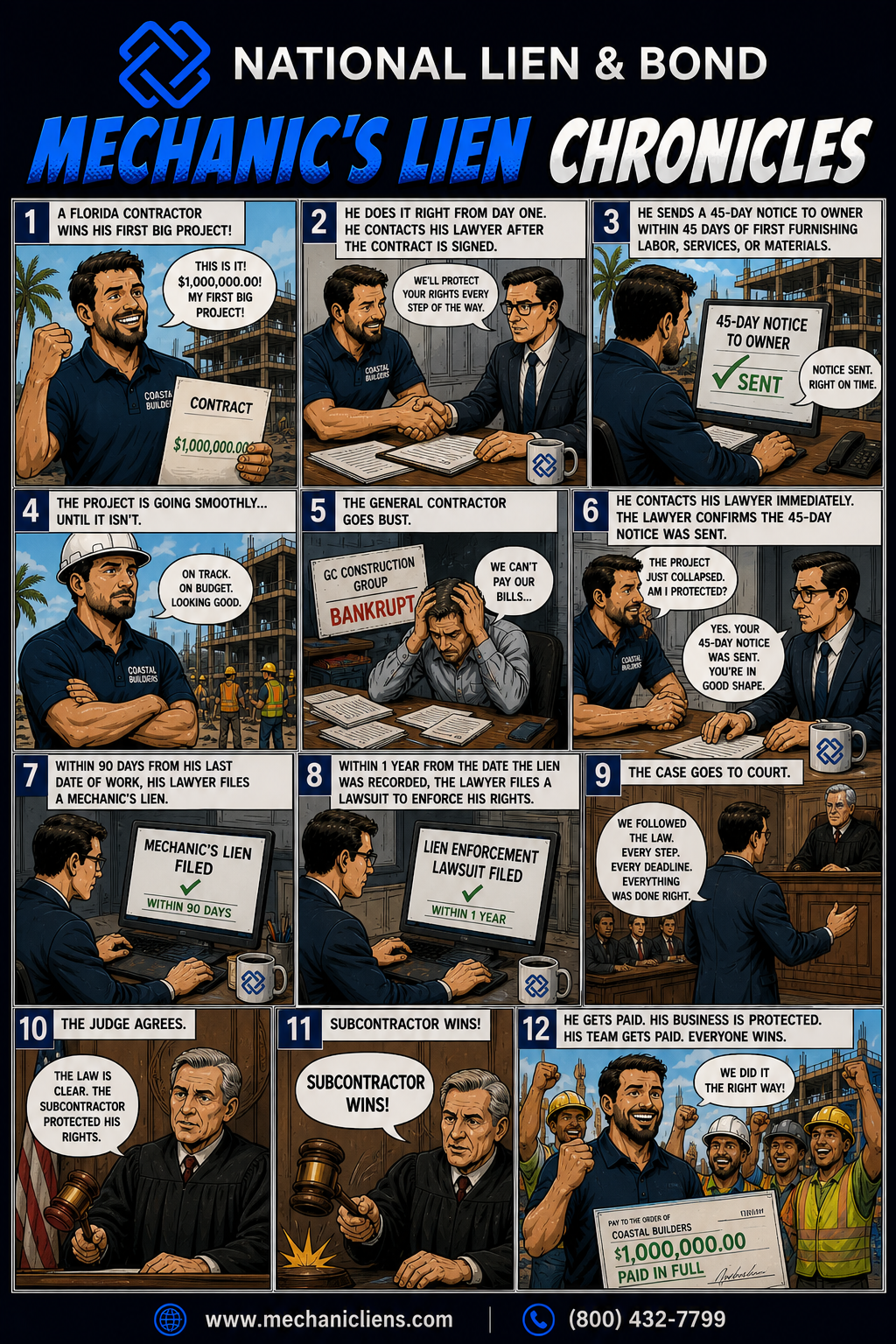
A Florida subcontractor — call him Coastal Builders — wins a $1 million subcontract on a private commercial project. The first thing he does after the contract is signed is call his lawyer. Within 45 days of starting work on site, his lawyer serves a Notice to Owner on the property owner identified on the recorded Notice of Commencement. Service is by certified mail with return receipt requested, with a copy retained in the file.
The job runs smoothly for months. Then the general contractor files for Chapter 11. The owner stops paying down the chain because there is now a dispute over what the GC was owed. Coastal Builders is unpaid for $1 million in completed work.
His lawyer does three things in sequence. Within 90 days of his last date of furnishing, the lawyer records a claim of lien in the official records of the county where the property is located, attaching the construction lien claim to the real property itself rather than to the bankrupt general contractor. Within one year of recording the lien, the lawyer files suit to foreclose. The case proceeds in state court, the owner cannot defeat a properly perfected lien claim, and Coastal Builders collects the full $1 million from the property — not from the bankruptcy estate, where construction creditors typically recover pennies on the dollar.
The whole arc turns on the 45-day Notice to Owner served at the start of the project. Without it, none of the rest of this story is possible.
Story Two — The Wrong Way
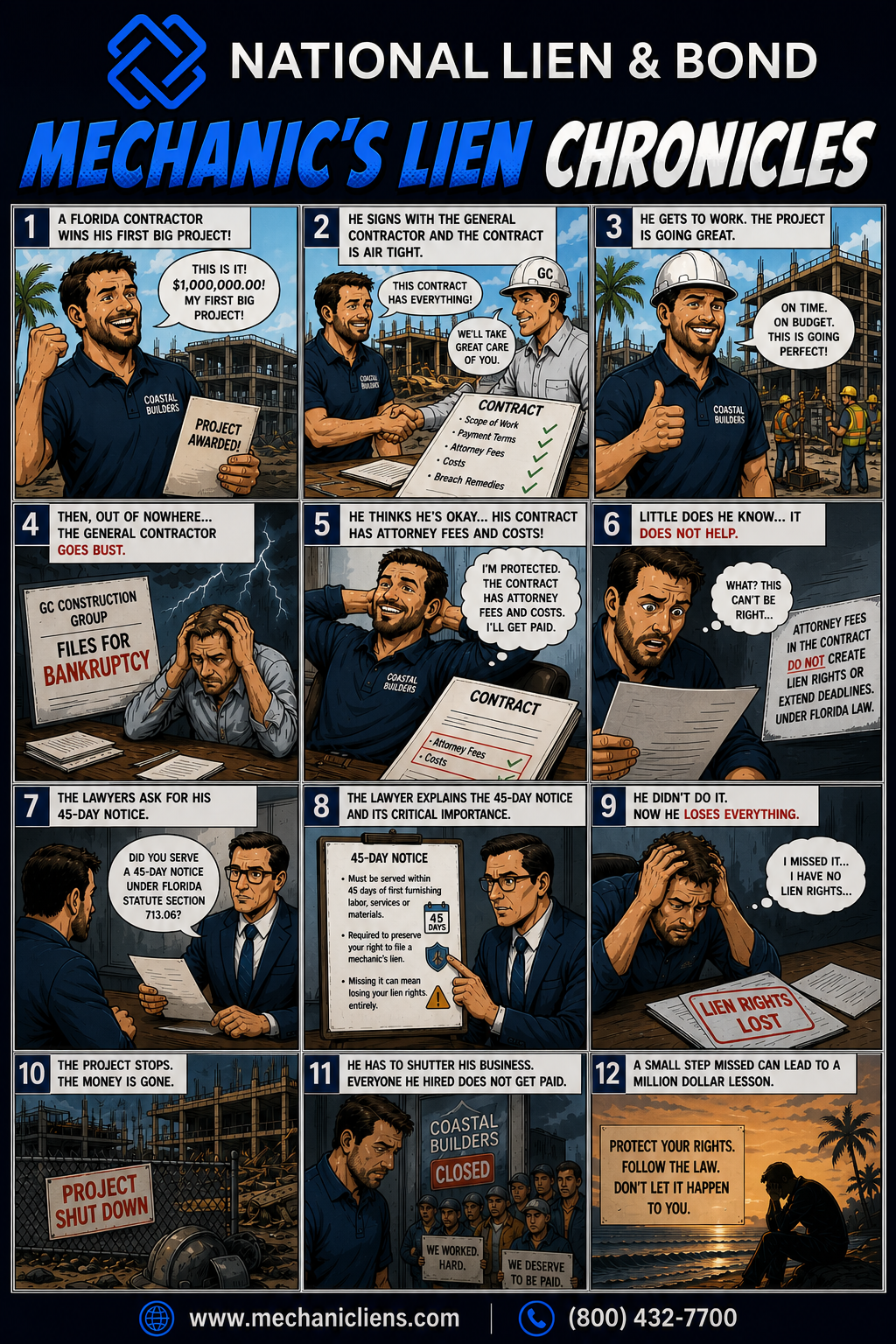
Same project. Same dollar amount. Same general contractor. Same bankruptcy. The only difference is that this subcontractor never served a Notice to Owner. He had a strong subcontract — clear scope, clean payment terms, an attorney-fee clause, a costs clause, and breach remedies. His contract is enforceable on its face.
The contract does not save him. When the general contractor files for bankruptcy, he calls counsel and is asked one question: did you serve a 45-day Notice to Owner under section 713.06? He did not. The attorney-fee clause in the subcontract governs the contract claim against the now-bankrupt general contractor. It does not create lien rights against the property. It does not extend or excuse the statutory notice period. It does not give him a claim against the owner's funds. Those rights flow only from the lien statute, and the lien statute requires the notice.
The unsecured contract claim he is left with goes into the bankruptcy estate alongside every other general unsecured creditor and recovers a small fraction of face value, if anything. He cannot pay his suppliers, his crew, or his payroll. The business closes. Everyone he hired is unpaid. The 45-day notice that would have changed all of this took an hour to prepare and the cost of certified mail.
What the Statute Actually Requires
Who Must Serve a Notice to Owner
Section 713.06 governs the lien rights of "lienors not in privity" with the owner. In plain English, that is anyone who does not have a direct contract with the property owner. Subcontractors and sub-subcontractors must serve a Notice to Owner. Material suppliers to the general contractor or to subcontractors must serve one. A material supplier to a sub-subcontractor must serve the notice on both the owner and the contractor. Equipment lessors qualify when their equipment is used on site to improve the property.
The general contractor in privity with the owner does not need to serve a Notice to Owner. Neither does anyone with a direct contract with the property owner. Everyone else in the construction chain on a private project does.
When the 45-Day Clock Starts
The deadline runs from the lienor's first actual furnishing of labor, services, or materials to the improvement of the property. It does not start on the contract execution date and it does not start on the first invoice. It starts on the first day work or material physically goes into the project. Materials specially fabricated for the job and delivered to a site warehouse have been treated by Florida courts as first furnishing in some cases; materials sitting at a remote warehouse for general inventory typically have not. When in doubt, count from the earliest physical event tied to the specific project and pick a service date inside that 45-day window with margin to spare.
What the Notice Must Contain
Section 713.06(2)(c) supplies a statutory form. A serviceable Notice to Owner identifies the lienor by name and address; the labor, services, or materials being furnished; the legal description of the property; the name of the person with whom the lienor has a contract; and a warning to the owner that failing to make payments to the contractor in accordance with the law may result in paying twice for the same labor or materials. Substantial compliance with the statutory form is the standard, but courts are not generous about deviations that prejudice the owner. Use the statutory form text or a counsel-vetted equivalent.
How to Serve It
Section 713.18 controls service. Acceptable methods include actual delivery to the person to be served, certified or registered mail with postage prepaid and return receipt requested, hand delivery by a process server, or other means specified in the statute. The persons to be served are identified on the recorded Notice of Commencement under section 713.13. If no Notice of Commencement is on record, serve the actual record owner of the property. Always serve the contractor as well when required by the statute, and always retain proof of service — the certified mail receipt, the return receipt card, and the postmarked envelope.
After the 45-Day Notice — the 90-Day and 1-Year Deadlines
The Notice to Owner is the gateway. Two further deadlines decide whether you collect.
The claim of lien itself must be recorded in the official records of the county where the property is located within 90 days of the lienor's final furnishing of labor, services, or materials. Section 713.08 supplies the form. The lien attaches to the real property and creates a security interest separate from any contract claim against the contractor. A lien recorded outside the 90-day window is a defective lien and is subject to discharge.
The lawsuit to enforce the lien must be filed within one year of the date the lien was recorded under section 713.22. The owner can shorten that window to 60 days by recording a Notice of Contest of Lien — once that notice is filed and served, the one-year window collapses. Calendar both dates the moment the lien is recorded.
Common Failure Modes
Counting from the contract date instead of first furnishing. The contract was signed on March 1, work began on April 10, and the subcontractor's lawyer calculates 45 days from March 1. The notice goes out on April 14 and is timely from the first-furnishing date but the team had no margin. On a project where first furnishing slips later, this approach produces late notices.
Treating the attorney-fee clause as a substitute. A robust subcontract is necessary but not sufficient. Lien rights come from the lien statute, not from the contract. The contract governs the claim against the general contractor; the lien governs the claim against the property and the owner's funds. They are separate legal theories and only one survives a contractor bankruptcy.
Serving the wrong owner. The Notice of Commencement identifies the persons to be served. If the project is owned by a single-purpose entity and the Notice of Commencement names the wrong entity or is never recorded, serve the record owner of the property under the official records and consider serving the named owner under the contract as well.
Skipping the notice on a project where the lienor is in privity with the GC but not the owner. First-tier subcontractors are not in privity with the owner — they have a contract with the general contractor. The 45-day notice is required.
No proof of service. Courts have rejected lien claims even when the notice was timely sent because the lienor could not produce a return receipt or a postmarked envelope. Make proof of service a checklist item, not an afterthought.
Public Works Are Different
This guide covers private commercial projects. On Florida public works, mechanic's liens cannot attach to public property. The substitute is the payment bond required under section 255.05, Florida's Little Miller Act, and the procedural notice for non-privity claimants on a public job is a Notice to Contractor served on the contractor and the surety, not a Notice to Owner served on the owner. The deadlines and the form differ. If your project is owned by a state, county, municipal, or other public entity, the analysis in this post does not apply and you should confirm the bond claim deadlines with counsel before relying on lien-statute timing.
Action Checklist for Florida Private Commercial Projects
On every Florida private commercial subcontract, run this routine. Pull the recorded Notice of Commencement at the start of the job and identify the persons to be served. Calendar the 45-day Notice-to-Owner deadline from the projected first-furnishing date and set it to fire 21 days out, 7 days out, and the day of. Serve the notice by certified mail with return receipt requested and retain the proof of service in the project file. On the day of last furnishing, calendar the 90-day lien-recording deadline. On the day the lien is recorded, calendar the one-year suit deadline and set a separate alert for the 60-day window in case a Notice of Contest of Lien is later filed.
The work to do all of this on a typical project takes a few hours and a few certified-mail receipts. The cost of skipping it, when the GC files for bankruptcy or the owner refuses to pay, is the entire receivable.
Frequently Asked Questions
I'm a Florida subcontractor working directly with the property owner. Do I still need to send a 45-day Notice to Owner?
No. Section 713.06, Florida Statutes, applies only to lienors who are not in privity with the owner. If you have a direct contract with the property owner — sometimes called being 'in privity' — the 45-day Notice to Owner requirement does not apply to you. You still must record a claim of lien within 90 days of last furnishing and file suit within one year of recording, but the front-end notice is for everyone else in the construction chain.
When does the 45-day clock start running?
From the first date you actually furnish labor, services, or materials to the project — not from the contract execution date and not from the first invoice. Florida courts treat the trigger as the earliest physical event tied to the specific project. Materials specially fabricated for and delivered to the site can count; materials sitting in a general-inventory warehouse typically do not. When in doubt, count from the earliest plausible date and serve the notice with margin to spare.
What happens if I serve the Notice to Owner on day 46?
A late Notice to Owner is fatal to the lien. Section 713.06(2)(a) conditions the right to a lien on timely service of the notice, and Florida courts have repeatedly enforced that requirement strictly. A few days late, the lien is unenforceable as a matter of law regardless of how strong your underlying contract claim is. There is no good-faith exception that saves a missed deadline.
My subcontract has an attorney-fee clause. Doesn't that protect me if the general contractor goes bankrupt?
No. The attorney-fee clause in your subcontract governs your contract claim against the general contractor. When the general contractor files for bankruptcy, that contract claim becomes an unsecured claim in the bankruptcy estate, where construction creditors typically recover pennies on the dollar. The clause does not create lien rights against the property, does not give you a claim against the owner's funds, and does not extend any statutory deadline. Lien rights and bond rights are separate legal theories that survive a contractor bankruptcy. The 45-day Notice to Owner is what unlocks the lien.
Sources
- 1.Fla. Stat. § 713.06 — Liens of Persons Not in Privity; Proper Payments
- 2.Fla. Stat. § 713.08 — Claim of Lien
- 3.Fla. Stat. § 713.13 — Notice of Commencement
- 4.Fla. Stat. § 713.18 — Manner of Serving Notices and Other Instruments
- 5.Fla. Stat. § 713.22 — Duration of Lien; Notice of Contest of Lien
- 6.Fla. Stat. § 255.05 — Bonds of Contractors Constructing Public Buildings (for the public-works contrast)
- 7.The Florida Bar — Construction Law Section: Construction Lien Practice Resources
Related Articles
Unpaid-Balance Lien States: Why You're Racing Against Two Deadlines, Not One
In an unpaid-balance lien state, the calendar deadline to record your lien is only half the race. The hidden second deadline is the moment the owner finishes paying the general contractor — because that payment can shrink or erase the fund your lien attaches to. This guide explains both deadlines, why subcontractors and suppliers lose money even when they file 'on time,' and the notice-and-timing strategy that protects your leverage.
Read Article
Connecticut Mechanics Lien Law: Notices, Deadlines, Lien Rights, and Contractor Registration
Connecticut treats original contractors and lower-tier claimants differently. This guide covers the lower-tier notice of intent, the 90-day certificate recording deadline, the 30-day owner-service requirement, the one-year foreclosure-and-lis-pendens deadline, the lienable-fund limit on subcontractor liens, who can claim, and how Home Improvement Act and New Home Construction registration affect enforcement.
Read Article
Delaware Mechanics Lien Law: Statement of Claim, Deadlines, Lien Rights, and Contractor Registration
Delaware enforces mechanics liens through a strictly construed statement of claim filed in Superior Court. This guide covers the 180-day and 120-day filing deadlines, the prior-written-consent rule for tenant work, the statement-of-claim pleading elements, the $25 threshold, who can claim, and Delaware contractor registration and business licensing.
Read Article