
When a General Contractor Goes Bankrupt, Can a Subcontractor File a Mechanic Lien?
The Immediate Impact
When a general contractor files for bankruptcy, 11 U.S.C. § 362(a) imposes an automatic stay that halts most collection actions against the debtor. You cannot sue the contractor, continue an existing lawsuit, levy on its assets, or enforce a judgment already entered. The stay is broad, and violating it can expose you to sanctions even when you act in good faith.
The stay does not, however, reach every right you hold. A claim against the property is a claim against the real estate, not against the contractor. A claim against a payment bond is a claim against the surety, not against the contractor. Used correctly, these rights survive the filing and often outperform the general unsecured recovery available through the bankruptcy case itself, which for construction creditors typically lands in the single-digit percentages.
The § 362(b)(3) Exception and the Relation-Back Doctrine
Section 362(b)(3) of the Bankruptcy Code creates a narrow but critical exception. It permits "any act to perfect, or to maintain or continue the perfection of, an interest in property" to the extent Section 546(b) protects that perfection. Section 546(b) in turn preserves any state law that allows a lien perfected after bankruptcy to be treated as effective against earlier interests, the so-called relation-back rule.
Most state mechanic lien statutes fit within Section 546(b). In Illinois, a properly filed lien relates back to the contractor's first date of furnishing labor or materials under 770 ILCS 60/1. California, Georgia, Texas, and most other jurisdictions follow the same principle. Where state law provides for relation-back, a post-petition lien filing does not violate the automatic stay, because Congress has expressly authorized it.
The practical rule is straightforward. If your state treats a mechanic's lien as arising out of the work rather than out of the filing, record the lien on the statutory timeline even after your contractor has filed for bankruptcy. Failing to file forfeits the security interest the statute provides and drops you into the general unsecured pool.
States Where the Exception Does Not Clearly Apply
Not every state qualifies. New Jersey is the clearest example. Under the New Jersey Construction Lien Law, N.J.S.A. 2A:44A-1 et seq., a lien attaches only upon filing of the claim. Courts interpreting New Jersey law have concluded the lien does not relate back within the meaning of Section 546(b), and the Section 362(b)(3) safe harbor therefore does not clearly protect post-petition filings. A lien recorded after the petition date may be voided by the debtor, the trustee, or the debtor in possession.
If you are a subcontractor or supplier on a New Jersey project and your contractor files for bankruptcy before you have recorded, assume the stay applies. Move for stay relief in the bankruptcy court before filing, or secure written consent from the debtor in possession on the record. A handful of other states have statutory frameworks that present the same risk, and local case law continues to develop. Confirm with counsel in the project state before relying on Section 362(b)(3).
Preserving Your Bond Claim Rights
Payment bonds operate on a separate track. The surety is a different legal entity from the contractor, and the bond is a separate contract between the surety, the principal, and the obligee. When the contractor files for bankruptcy, the surety's obligations under the bond remain intact. Section 362(a) does not enjoin actions against non-debtor third parties.
Comply with every statutory deadline in the bond claim process as if the bankruptcy had not happened. On federal Miller Act projects, 40 U.S.C. § 3133 requires a notice within 90 days of last furnishing for second-tier claimants, and suit between 90 days and one year after last furnishing. State Little Miller Act deadlines vary but are equally unforgiving. The bankruptcy does not extend any of them, and the surety will assert every procedural defense available under the bond and the governing statute.
Filing a Proof of Claim
Even when lien and bond rights are secure, file a proof of claim in the bankruptcy case. In a Chapter 11 case, the bar date is set by order of the court, typically 70 days after the order for relief. In a Chapter 7 case, the deadline is 70 days after the order for relief for governmental units and generally tracks the meeting of creditors for other claimants. The court will reject claims filed after the bar date absent cause.
File a secured claim if your lien has been perfected and is supported by an interest in property of the estate. File an unsecured claim for amounts not covered by lien or bond rights. Do not treat the claim as duplicative of the lien. Properly drafted, it preserves your position if a later challenge to the lien succeeds, and it entitles you to notice of plan confirmation, sale motions, and distribution.
Direct Payment from the Owner
If the owner holds unpaid contract balances due to the general contractor, those balances are a target worth pursuing. In most states the owner has the right to withhold payment to avoid double-payment exposure, and may pay directly to lower-tier claimants against a pending lien. Put the demand in writing, cite the lien and the statutory basis, and offer to release upon payment.
The trustee may argue the owner's direct payment interferes with property of the estate. In most circuits, where the state lien statute gives the claimant a direct claim against owner funds tied to the work, the owner's payment is not a transfer of the debtor's property and is not subject to turnover under Section 542. Confirm the posture with counsel before directing the owner, because the analysis turns on the state lien statute's language.
Preference Payments and the 90-Day Look-Back
If the contractor paid you within 90 days of the petition date, or within one year if you are an insider, the trustee may bring a preference action under 11 U.S.C. § 547 to claw the payment back. The exposure is real. Construction preference complaints often target every payment received during the look-back window.
Defenses exist. The ordinary course of business defense under Section 547(c)(2) protects payments made consistent with established pre-bankruptcy billing practice. The new value defense under Section 547(c)(4) protects payments offset by subsequent labor or materials furnished on credit. Both defenses are fact-intensive. Document the billing cycle, preserve invoices and delivery tickets for each payment in the window, and track credit extended after each receipt. Contractors who keep clean records fare materially better than those who do not.
Executory Contracts and Ongoing Work
If the project is still active, the debtor may seek to assume or reject the subcontract under 11 U.S.C. § 365. A subcontract with a bankrupt general is an executory contract while performance remains due on both sides. If the contract is assumed, the debtor must cure all defaults, which includes the unpaid balance on your invoices. If it is rejected, you hold an unsecured damages claim computed as of the petition date.
Do not continue performing under a silent contract while the debtor deliberates. Serve a written demand that the debtor elect to assume or reject on a prompt schedule under Section 365(d). Withhold performance where you are contractually entitled until adequate assurance of future performance is provided or the contract is assumed with cure paid.
Action Checklist
Within seven days of learning of the filing, identify every open project involving the debtor, calendar the state lien deadline for each, confirm whether a payment bond is posted, and put the surety on notice of the claim. Pull records on every payment received in the ninety days before the petition date. File lien claims in every state whose law clearly qualifies for the Section 362(b)(3) exception. Seek stay relief in any state where qualification is unclear. File a proof of claim before the bar date. Engage bankruptcy and construction counsel early. The window to preserve meaningful recovery in a contractor bankruptcy is short, and the default result for unsecured creditors is pennies on the dollar.
Frequently Asked Questions
Does the automatic stay prevent me from filing a mechanic's lien?
In most states, no. Section 362(b)(3) of the Bankruptcy Code, read together with Section 546(b), permits post-petition perfection of a lien when state law allows the lien to relate back to a pre-petition date such as the first date of furnishing. Illinois, California, Georgia, Texas, and most other jurisdictions qualify. New Jersey is the principal outlier because its lien attaches only on filing. In a non-qualifying state, seek stay relief before recording.
How long do I have to file a proof of claim?
In a Chapter 11 case, the court sets a bar date, commonly 70 days after the order for relief. In a Chapter 7 case, the deadline generally tracks the meeting of creditors under Section 341, with longer periods for governmental units. Missing the bar date typically bars recovery on the unsecured portion of the claim, so calendar the date as soon as the notice arrives.
Can I still pursue the payment bond after the general contractor files bankruptcy?
Yes. The surety is a non-debtor third party, and the automatic stay under Section 362(a) does not enjoin actions against non-debtors. All statutory deadlines for bond claims continue to run. Miller Act, Little Miller Act, and private bond deadlines apply exactly as if the bankruptcy had not been filed.
I was paid within 90 days of the bankruptcy filing. Am I exposed to a preference claim?
Potentially. Section 547 permits the trustee to recover payments made within 90 days of the petition, or one year for insiders. The ordinary course defense under Section 547(c)(2) and the new value defense under Section 547(c)(4) are the usual answers. Preserve invoices, delivery records, and evidence of the established billing cycle before the case is filed, because the trustee will demand them.
Sources
- 1.11 U.S.C. § 362 — Automatic Stay Provisions
- 2.11 U.S.C. § 362(b)(3) — Exception for Perfection of Statutory Liens
- 3.11 U.S.C. § 546(b) — Relation-Back Perfection
- 4.11 U.S.C. § 547 — Preference Actions and Defenses
- 5.11 U.S.C. § 365 — Executory Contracts
- 6.40 U.S.C. § 3133 — Miller Act Payment Bond Claims
- 7.N.J.S.A. 2A:44A-1 et seq. — New Jersey Construction Lien Law
- 8.American Bankruptcy Institute — Construction Industry Resources
Related Articles
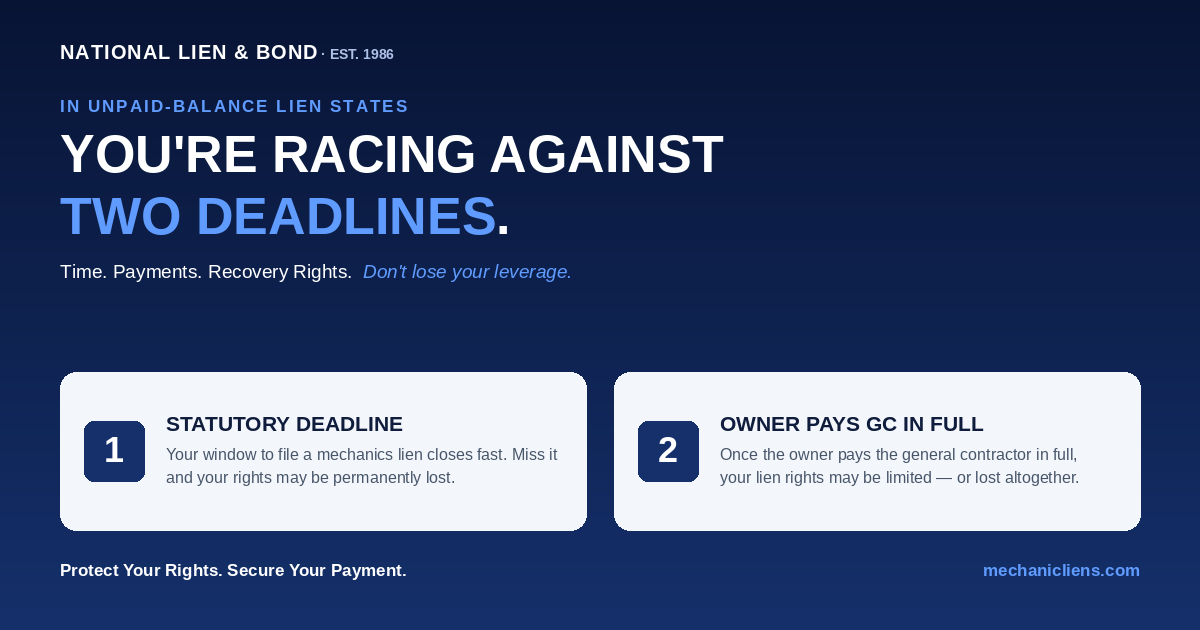
Unpaid-Balance Lien States: Why You're Racing Against Two Deadlines, Not One
In an unpaid-balance lien state, the calendar deadline to record your lien is only half the race. The hidden second deadline is the moment the owner finishes paying the general contractor — because that payment can shrink or erase the fund your lien attaches to. This guide explains both deadlines, why subcontractors and suppliers lose money even when they file 'on time,' and the notice-and-timing strategy that protects your leverage.
Read Article
Connecticut Mechanics Lien Law: Notices, Deadlines, Lien Rights, and Contractor Registration
Connecticut treats original contractors and lower-tier claimants differently. This guide covers the lower-tier notice of intent, the 90-day certificate recording deadline, the 30-day owner-service requirement, the one-year foreclosure-and-lis-pendens deadline, the lienable-fund limit on subcontractor liens, who can claim, and how Home Improvement Act and New Home Construction registration affect enforcement.
Read Article
Delaware Mechanics Lien Law: Statement of Claim, Deadlines, Lien Rights, and Contractor Registration
Delaware enforces mechanics liens through a strictly construed statement of claim filed in Superior Court. This guide covers the 180-day and 120-day filing deadlines, the prior-written-consent rule for tenant work, the statement-of-claim pleading elements, the $25 threshold, who can claim, and Delaware contractor registration and business licensing.
Read Article