
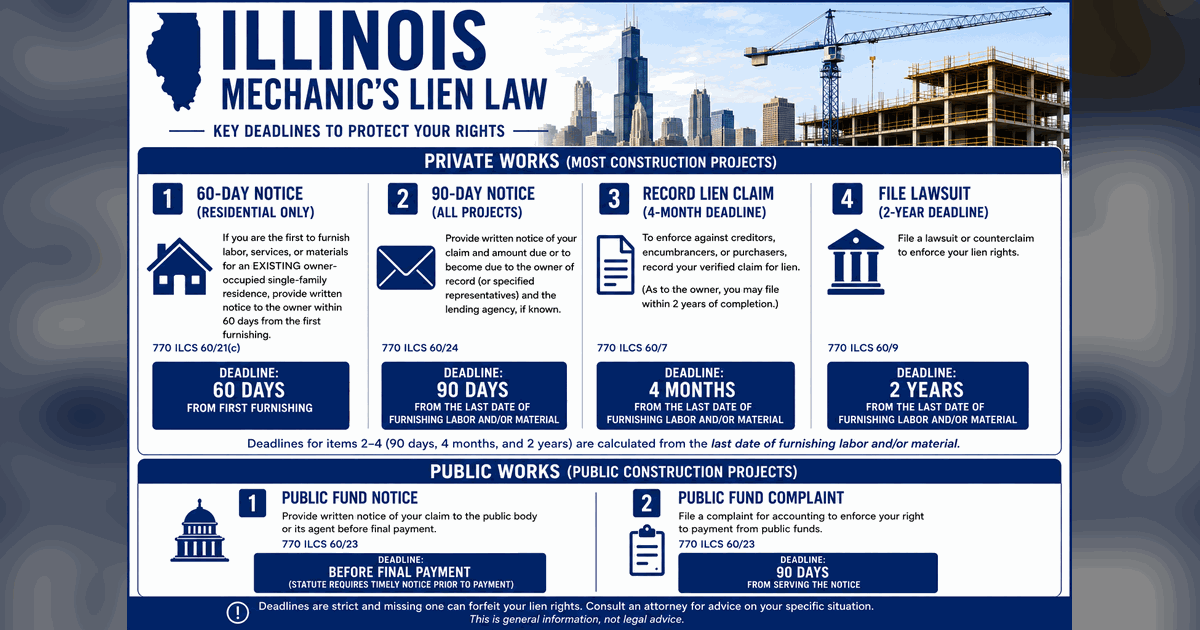
How an Illinois Subcontractor Protects the Right to Get Paid: The 90-Day Notice, the 4-Month Recording Deadline, and the 2-Year Suit Window
You finished the work. The general contractor says the owner has not funded the draw. The owner says it already paid the GC. The lender says it needs one more waiver package. While everyone talks, your Illinois lien rights are running on dates that are easy to miss and hard to fix later.
For an Illinois subcontractor or material supplier, the key dates are usually: when you first furnished on an owner-occupied single-family residence, when you completed your subcontract or last furnished extra work or materials, when you served the 90-day notice, when you recorded the lien claim, and whether you filed suit within 2 years.
Illinois mechanic's liens are governed by the Illinois Mechanics Lien Act, 770 ILCS 60/0.01 et seq. The remedy is powerful, but it is statutory. Courts expect lien claimants to follow the statute. This guide is educational only. It is not legal advice, and reading it does not create an attorney-client relationship.
Who Has Lien Rights in Illinois — and Who Doesn't
Illinois gives lien rights to those who improve real property through labor, services, material, fixtures, apparatus, machinery, forms, or form work. A contractor with a contract directly with the owner, or with someone the owner authorized or knowingly permitted to contract, has lien rights under 770 ILCS 60/1.
Subcontractors also have lien rights. 770 ILCS 60/21 defines a subcontractor broadly to include a mechanic, worker, or other person furnishing labor, services, material, fixtures, apparatus, machinery, or forms/form work for the contractor. The subcontractor's lien arises from the same time and on the same property as the contractor's lien, and it also reaches money due or to become due from the owner under the original contract.
That is the basic protection Illinois gives to subs and suppliers: if your work or materials improved the project and you are in the statutory chain, the Act can give you a lien or a claim to project funds.
But the details matter. Illinois has different rules for contractors and subcontractors, a special notice rule for existing owner-occupied single-family residences, and separate public-works remedies. Do not assume a lien is valid just because your material reached the jobsite. The first questions we ask in practice are: who hired you, what property was improved, what type of property is it, when did you first and last furnish, and what notices have already gone out?
The Subcontractor's 90-Day Notice: Who Gets It and When
Illinois does not use the 10-day Notice of Intent that some states require before recording. For Illinois subcontractors and suppliers, the core private-project notice is the 90-day notice under 770 ILCS 60/24.
A subcontractor or party furnishing labor, materials, fixtures, apparatus, machinery, or services may send notice any time after making its contract, but must do so within 90 days after completion of the subcontract. If extra or additional work or material is furnished later, the deadline runs within 90 days after completion of that extra/additional work or final delivery of that extra/additional material.
The notice must state the claim and the amount due or to become due. It must be provided to the owner of record, or the owner's agent, architect, or superintendent having charge of the improvement, and to the lending agency if known. Under the current statute, the notice may be sent by registered or certified mail with return receipt requested, by a nationally recognized delivery company with tracking service, or by personal service. Notice is considered served when it is placed with the delivery service or in the mail.
This notice is not a courtesy letter. It is the document that tells the owner and lender that you are claiming unpaid money on the project. If the owner keeps paying the general contractor after proper notice without protecting your claim, the owner may create lien exposure that could have been avoided by requiring waivers or withholding funds.
The Owner-Occupied Single-Family Trap: 60 Days From First Furnishing
Illinois has a separate trap for subcontractors on an existing owner-occupied single-family residence. Under 770 ILCS 60/21(c), a subcontractor furnishing labor, services, materials, fixtures, apparatus, machinery, or forms/form work for an existing owner-occupied single-family residence must notify the occupant within 60 days from first furnishing in order to preserve the lien.
That notice must identify the subcontractor or material supplier, the start date, the type of work or materials furnished and to be furnished, and the contractor who requested the work. It must also warn the owner to obtain lien waivers before paying the contractor.
A late notice is not always fatal in every circumstance. 770 ILCS 60/21(c) says a notice given after 60 days preserves the lien only to the extent the owner has not been prejudiced by payments made before receiving the notice. In Crawford Supply Co. v. Schwartz, 919 N.E.2d 5 (Ill. App. 2009), the court held that a subcontractor's failure to serve the 60-day notice did not render the lien invalid as a matter of law where prejudice was not shown. But that is not a reason to ignore the deadline. It is a litigation issue you would rather avoid.
In the field, this is one of the most common Illinois mistakes. A supplier treats a custom home remodel like a commercial project, waits until the account is seriously past due, then sends only the 90-day notice. By then, the homeowner may have paid the contractor. That can turn a collectible lien into a fight over prejudice and payments.
The 4-Month Recording Deadline
For practical purposes, Illinois lien claimants should treat 4 months after completion as the recording deadline. Under 770 ILCS 60/7, a contractor cannot enforce the lien against or to the prejudice of another creditor, encumbrancer, or purchaser unless, within 4 months after completion, the claimant either brings an action to enforce the lien or records a verified claim for lien in the county where the improvement is located.
The claim for lien must include a brief statement of the contract, the balance due after credits, and a property description sufficient to identify the property. It must be verified by affidavit of the claimant or the claimant's agent or employee.
The statute has an owner-facing rule that is more forgiving: as to the owner, a lien claim may be filed within 2 years after completion of the contract, completion of extra work, or furnishing of extra labor, services, material, fixtures, apparatus, machinery, or forms/form work. But in real payment disputes, waiting beyond four months is dangerous. A later recording may lose effectiveness against purchasers, lenders, and other encumbrancers.
That is why we usually calendar the Illinois lien recording deadline as 4 months from completion or last qualifying extra/additional work or material. If you wait for the two-year outside window, you may preserve less than you think.
What Counts as Completion or Last Work?
Illinois recognizes that extra or additional work can affect the lien timeline. 770 ILCS 60/7 and 770 ILCS 60/9 both refer to completion of extra or additional work and furnishing of extra or additional material.
But not every late visit is safe to use as a new deadline. Illinois courts look at whether the later work was genuinely part of the contract or extra/additional work, rather than an attempt to revive an expired lien. In Daily v. Mid-America Bank & Trust Co. of Carbondale, 474 N.E.2d 788 (Ill. App. 1985), the court allowed later work to support timeliness where the contractor had performed continuing project work and the later work fit the parties' ongoing practice of additional work requests. The court distinguished situations involving a completed contract or an attempt to revive a lost lien through later adjustment, repair, or maintenance.
The practical rule: do not count from a warranty call, minor repair, replacement part, or courtesy visit unless counsel has reviewed the facts. Count conservatively from the last substantial labor, services, or materials for which the lien is claimed.
The 2-Year Suit-to-Enforce Window
Recording a lien claim is not the end of the process. Under 770 ILCS 60/9, the suit to enforce the lien must be commenced, or a counterclaim filed, within 2 years after completion of the contract, completion of extra or additional work, or furnishing of extra or additional material.
This is longer than the six-month window some states use, but it is not optional. A lien that is recorded and then left alone can still die if no enforcement action is filed within the statutory period.
There is also a separate Illinois demand procedure that can accelerate the need to sue in some cases. If you receive a statutory demand to enforce or release the lien, do not put it in the stack with ordinary project correspondence. It can shorten the practical response time and should be reviewed immediately.
Settlement discussions do not automatically extend the enforcement deadline. If the owner, general contractor, or lender wants more time to negotiate, get legal advice before relying on that conversation. The safest practice is to calendar the 2-year deadline when the lien is prepared, not when negotiations fail.
The Sworn Contractor Statement and Lien Waivers
Illinois payment disputes often turn on the sworn contractor statement. Under 770 ILCS 60/5(a), before paying the contractor, the owner must require a sworn or verified statement listing the names and addresses of all parties furnishing labor, services, materials, fixtures, apparatus, machinery, or forms/form work and the amounts due or to become due to each.
This is not just paperwork. The sworn statement is designed to tell the owner who must be protected before money goes downstream. In practice, a subcontractor or supplier should ask whether it was listed on the sworn statement, whether the owner paid after receiving notice of the claim, and whether waivers were exchanged accurately.
Lien waivers are another pressure point. Illinois's construction trust statute, 770 ILCS 60/21.02, applies when an owner, contractor, subcontractor, or supplier of any tier requests or requires a lien waiver in exchange for payment or a promise of payment. The sums received as a result of that waiver are held in trust for the person who furnished the labor, services, materials, fixtures, apparatus, machinery, or forms/form work, or the person otherwise entitled to payment for the waiver. Knowingly using those trust funds for another purpose can create civil liability.
Illinois also has a separate fraud provision. Under 770 ILCS 60/21.01, a contractor, or a corporate officer or employee, commits a Class A misdemeanor if, with intent to defraud, the contractor induces a subcontractor to deliver a lien waiver so the contractor can obtain payment, represents that the contractor will pay the subcontractor from that payment, and then willfully fails to pay the subcontractor in full within 30 days after receiving the payment.
The lesson for subs and suppliers is straightforward: do not sign unconditional waivers unless the payment mechanics are clear. If a waiver is required to release funds, match the waiver to the amount actually paid or use a conditional waiver where appropriate.
Public Works: No Lien on Public Property, but Claims Against Funds and Bonds
If the project is public, you usually do not lien the public property itself. Illinois provides alternative remedies.
First, 770 ILCS 60/23 gives certain claimants a lien against public funds due or to become due to the contractor on a public improvement. The claimant must serve a written notice of claim before payment is made. The notice must include a sworn statement identifying the claimant's contract, describing the work, and stating the amount due and unpaid. After serving the notice, the claimant must file a complaint for accounting within 90 days and notify the public official within the statutory period. If the claimant does not file the accounting action in time, the public-funds lien terminates.
Second, the Illinois Public Construction Bond Act, 30 ILCS 550/2, gives claimants on covered public projects the right to sue on the bond or letter of credit. The claimant must file a verified notice of claim within 180 days after last work or last furnishing and provide a copy to the contractor within 10 days after filing. Suit must be brought no later than 1 year after last furnishing.
Public work therefore has its own calendar: public-funds notice and 90-day accounting deadline on one track; bond notice and one-year suit deadline on another. If you are unpaid on an Illinois public project, request the bond, identify the public body, and calendar both remedies early.
Common Failure Modes
Missing the 90-day notice. A subcontractor's 90-day notice under 770 ILCS 60/24 is often the step that turns an unpaid invoice into a protected lien claim.
Forgetting the 60-day residential notice. On an existing owner-occupied single-family residence, first furnishing matters. Waiting until the end of the job can create a fight over owner prejudice.
Recording after four months and assuming the lien is fully protected. The two-year owner rule does not replace the practical need to record within 4 months to preserve rights against third parties.
Using a weak "last work" date. Warranty work, minor repair, or a courtesy trip may not safely extend the deadline. Count conservatively unless the later work was genuine extra/additional contract work.
Signing broad lien waivers before money clears. Illinois trust and fraud provisions may help after the fact, but the better practice is to control waiver language before payment is released.
Treating a public job like a private lien. Public-funds claims and bond claims have different notices, recipients, and suit deadlines.
Action Checklist for Illinois Subcontractors
- Identify whether the project is private or public.
- Confirm whether the property is an existing owner-occupied single-family residence.
- Record your first furnishing date for residential 60-day notice analysis.
- Record your completion / last furnishing date for the 90-day notice, 4-month recording, and 2-year suit deadlines.
- Serve the 90-day notice under 770 ILCS 60/24 on the owner of record or proper representative, and the lender if known.
- On qualifying owner-occupied single-family residences, serve the 60-day notice under 770 ILCS 60/21(c).
- Prepare a verified claim for lien with the contract statement, balance due after credits, and property description.
- Record within 4 months when third-party priority matters.
- Calendar the 2-year enforcement deadline immediately.
- Ask for the sworn contractor statement and track whether you were listed.
- Do not sign unconditional lien waivers unless the payment arrangement supports it.
- On public work, request the bond and calendar the public-funds and bond-claim deadlines separately.
Illinois lien law is manageable if you treat it as a deadline system, not a collection letter. The earlier you identify the property type, your tier, and your first and last furnishing dates, the more options you usually have.
National Lien & Bond helps contractors, subcontractors, and suppliers review lien and bond deadlines nationwide. If you are unpaid on an Illinois project, you can ask us to review your dates, notices, lien claim, and waiver history before the deadline window closes. No publication can guarantee a result or replace legal advice on your specific facts, but an early deadline review can prevent expensive mistakes.
Frequently Asked Questions
What is the 90-day notice for Illinois subcontractors?
The 90-day notice is the written notice required by 770 ILCS 60/24. A subcontractor or supplier must provide notice of its claim and the amount due or to become due within 90 days after completion of its work, or after extra/additional work or final delivery of extra/additional material.
Is there a separate notice for Illinois residential projects?
Yes. For an existing owner-occupied single-family residence, 770 ILCS 60/21(c) requires a subcontractor to notify the occupant within 60 days from first furnishing. A late notice may preserve the lien only to the extent the owner was not prejudiced by payments made before receiving notice.
When should an Illinois mechanic's lien be recorded?
To preserve rights against creditors, encumbrancers, and purchasers, a verified claim for lien should generally be recorded within 4 months after completion or completion/final delivery of extra or additional work or materials under 770 ILCS 60/7.
How long do you have to sue to enforce an Illinois mechanic's lien?
Under 770 ILCS 60/9, suit must be commenced or a counterclaim filed within 2 years after completion of the contract, completion of extra/additional work, or furnishing of extra/additional material.
Can an Illinois subcontractor lien public property?
Generally, no. On public projects, Illinois provides a lien against public funds under 770 ILCS 60/23 and a bond remedy under 30 ILCS 550/2. Those remedies have separate notice and suit deadlines.
Sources
- 1.770 ILCS 60/1 — Contractor lien rights and definition of improvement.
- 2.770 ILCS 60/5 — Sworn contractor statement and owner-occupied single-family residence notice framework.
- 3.770 ILCS 60/7 — Claim for lien; four-month recording/action requirement against third parties; two-year owner filing concept.
- 4.770 ILCS 60/9 — Suit or counterclaim to enforce lien within two years.
- 5.770 ILCS 60/21 — Subcontractor definition, subcontractor lien rights, 60-day owner-occupied single-family notice, and pay-if-paid limitation.
- 6.770 ILCS 60/21.01 — Fraud / lien-waiver misdemeanor provision.
- 7.770 ILCS 60/21.02 — Construction trust funds tied to lien waivers.
- 8.770 ILCS 60/23 — Liens against public funds and 90-day complaint-for-accounting requirement.
- 9.770 ILCS 60/24 — Subcontractor 90-day notice and service methods.
- 10.30 ILCS 550/2 — Illinois Public Construction Bond Act right to sue, 180-day verified notice, and one-year suit deadline.
- 11.Daily v. Mid-America Bank & Trust Co. of Carbondale, 474 N.E.2d 788 (Ill. App. 1985).
- 12.Crawford Supply Co. v. Schwartz, 919 N.E.2d 5 (Ill. App. 2009).
- 13.Tefco Construction Co. v. Continental Community Bank, 829 N.E.2d 860 (Ill. 2005).
- 14.Cyclonaire Corp. v. ISG Riverdale, Inc., 882 N.E.2d 684 (Ill. App. 2007).
- 15.Seasons-4, Inc. v. Hertz Corp., 788 N.E.2d 179 (Ill. App. 2003).
Related Articles

How a Colorado Subcontractor Protects the Right to Get Paid: The Notice of Intent, the 4-Month Lien Deadline, and the 6-Month Suit Window
Colorado subcontractors and suppliers usually protect payment rights by serving a Notice of Intent, recording a lien within 4 months, and filing suit within 6 months. Here is how the deadlines work, what commonly goes wrong, and how public-works bond claims differ.
Read Article
The Miller Act Deadlines That Decide Whether You Get Paid on a Federal Project
You cannot lien a federal courthouse, an Army base, or a VA hospital. On a federal construction project the payment bond is your security, and two Miller Act deadlines decide whether you collect: a 90-day notice and a one-year suit window.
Read Article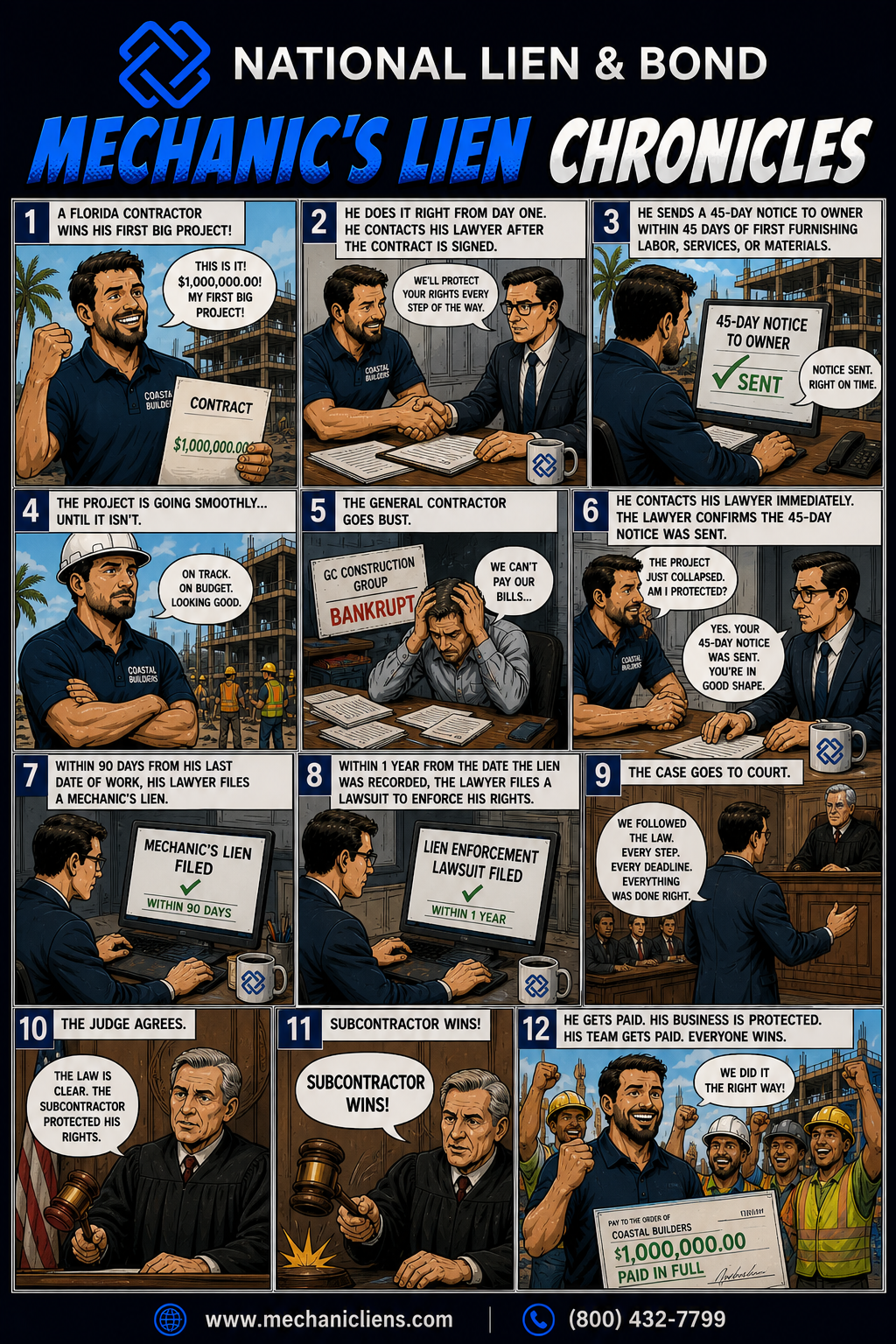
Florida's 45-Day Notice to Owner: The Line Between Getting Paid and Closing Your Doors
On a Florida private commercial project, missing the 45-day Notice to Owner deadline destroys your lien rights — and the attorney-fee clause in your subcontract will not save you. A side-by-side story of one missed step worth a million dollars.
Read Article