
Unpaid-Balance Lien States: Why You're Racing Against Two Deadlines, Not One
Most contractors and suppliers know there is a deadline to file a mechanics lien. Fewer realize that, in an unpaid-balance lien state, there is a second deadline running at the same time — and it is the one that quietly costs people the most money. You can file your lien perfectly, days before the statutory cutoff, and still recover little or nothing, because the dollars your lien was supposed to attach to are already gone.
This post explains both deadlines, why the second one is invisible on a calendar, and the practical notice-and-timing moves that keep your leverage intact.
The Two Deadlines, Side by Side
In a full-price lien state, your lien attaches to the property for the full value of the labor and materials you furnished — even if the owner has already paid the general contractor in full for your scope. The property is your security, period. In an unpaid-balance lien state, your lien is capped at the amount the owner still owes the general contractor when your lien attaches. That single difference creates a second, payment-driven deadline that has nothing to do with the date on the statute.
| Deadline | What it is | What happens if you miss it |
|---|---|---|
| 1. The statutory deadline | A fixed calendar window — set by state law — to serve any required preliminary notice and record your lien (often measured from your last day of furnishing labor or materials). | Your lien rights can be permanently lost. There is rarely a cure for a late filing. |
| 2. The owner-pays-the-GC deadline | The moment the owner finishes paying the general contractor for the project. In an unpaid-balance state, the unpaid contract balance is the ceiling for what your lien can reach. | Your lien may attach to little or nothing. You can be fully unpaid and still hold a lien worth a fraction of what you are owed — or worth zero. |
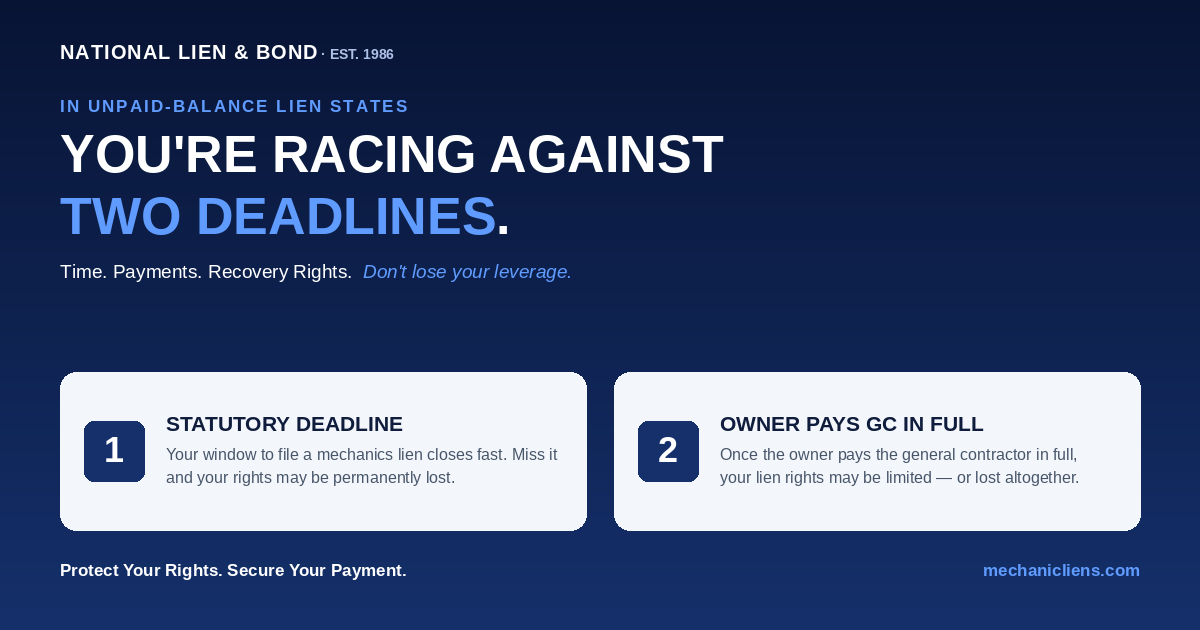
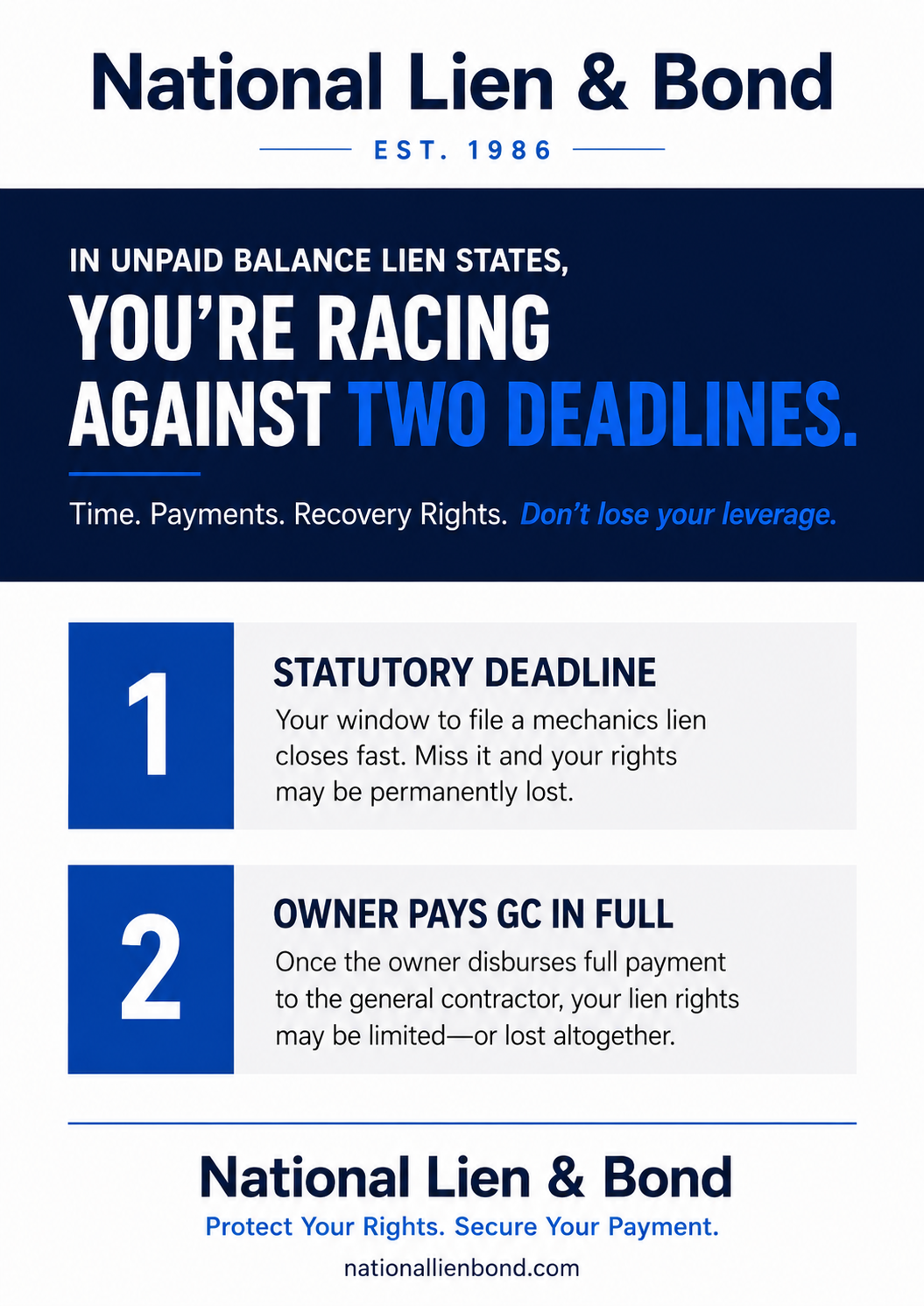
The first deadline is on a calendar. The second one is on the owner's checkbook — and you usually cannot see it coming. That is what the graphic above is getting at: in unpaid-balance states, both clocks are running, and the money clock often runs out first.
Why "Filing On Time" Isn't Enough
Here is the scenario that catches good companies. A subcontractor finishes work in March. The state gives, say, a generous window to record a lien measured from last furnishing. The sub waits — chasing payment by phone, trusting the GC's "the check is coming" — and records a valid lien near the end of the window. Everything about the filing is correct and timely.
But during those weeks of waiting, the owner kept paying the GC. By the time the lien attaches, the owner has paid the general contractor in full and has little or no remaining contract balance. In an unpaid-balance state, the lien attaches only to what the owner still owes. The sub's recovery against the property collapses, and the sub is left chasing a general contractor who may be insolvent, gone, or stalling for exactly this reason.
The lien was timely. The leverage was not. In an unpaid-balance state, your real deadline is the earlier of the statutory cutoff and the day the owner finishes paying upstream.
How to Win the Race: Move the Money Clock In Your Favor
You cannot control when the owner pays the GC, but you can change how much is still in the owner's hands when your claim is on record. Three levers do most of the work.
1. Serve your preliminary or pre-lien notice early — not at the deadline
Many states let lower-tier claimants notify the owner (or the party disbursing funds) that they have furnished or will furnish labor and materials. Once that notice lands, the owner is on notice of your claim and, in several states, is expected to hold back enough to cover it before releasing further payment to the GC. The earlier the notice arrives, the larger the unpaid balance still sitting with the owner — and the higher the ceiling for your lien. Serving the same notice on day 89 of a 90-day window is technically timely but strategically late: by then the owner may already have paid the contract out. See our overview of preliminary notice requirements by state and the distinction between a Notice to Owner and a preliminary notice.
2. Know your state's category before the job starts — not after you're unpaid
Whether you are in a full-price or unpaid-balance jurisdiction changes your entire strategy. In a full-price state, timing is about statutory preservation: the property is on the hook for the value you furnished regardless of upstream payments. In an unpaid-balance state, timing is about preserving the fund. Some states do not fit neatly in either box. Illinois, for example, is generally an unpaid-balance state, but the owner's protection turns on whether the general contractor delivered a proper sworn statement — which is why Illinois subs and suppliers should serve a 90-day Notice to Owner regardless. Our full-price vs. unpaid-balance guide maps where every state lands and flags the special rules (sworn-statement requirements, contract-price caps, and residential-vs-commercial splits).
3. Document the fund and tie your claim to the project
In an unpaid-balance dispute, the unpaid contract balance becomes a live factual question: what did the owner still owe when your lien attached, and what payments were made before the owner received notice of your claim? Keep contracts, change orders, pay applications, invoices, delivery tickets, and payment history organized by project. A claim you can document to the dollar — and tie to the specific improvement — is the claim that survives an owner's "we already paid" defense.
Owners and General Contractors See the Same Two Clocks Differently
The two-deadline framing cuts both ways. In an unpaid-balance state, an owner who has paid the GC in full, in accordance with statutory requirements and any required sworn statements or waivers, is largely protected from downstream liens. That is precisely why owners push to pay the contract out and why GCs sometimes encourage it. For unpaid subs and suppliers, that protective wall is the second deadline closing. Understanding the incentive on the other side of the table is half of protecting yourself: the owner is racing to finish paying, and every week you wait helps them get there.
Practical Takeaways
- In an unpaid-balance state you face two deadlines: the statutory filing cutoff and the moment the owner finishes paying the general contractor.
- A perfectly timed lien can still recover little if the owner has already paid the GC in full — the unpaid balance is your ceiling.
- Serve preliminary or pre-lien notices early. Early notice means a larger unpaid balance still held by the owner and a higher lien ceiling.
- Confirm whether your project sits in a full-price or unpaid-balance jurisdiction before you start work, and watch for hybrid rules (Illinois sworn statements, project-type splits, contract-price caps).
- Document the contract balance, your scope, and your last furnishing date so you can rebut an owner's "we already paid" defense.
- Don't wait for the statutory deadline to act. In unpaid-balance states, the money clock usually runs out first.
How National Lien & Bond Helps You Beat Both Clocks
National Lien & Bond was built around exactly this problem. When you submit a project, we identify whether it falls in a full-price or unpaid-balance jurisdiction, flag any special rules, and serve the right preliminary notices early — while there is still a balance for your lien to reach. We track every statutory deadline automatically and send notices by certified mail with proof of service, so the owner is on notice before they pay the contract out. If a claim has to escalate, attorney Tom is available in the background to take it the rest of the way. You protect your leverage on the money clock and the calendar clock at the same time.
Disclaimer
This post provides general information about full-price and unpaid-balance mechanics lien rules and is not legal advice. State statutes, notice requirements, deadlines, and exceptions vary widely and change over time, and the correct strategy depends on your role, your contract chain, the project type, and the specific state. Contractors, subcontractors, and suppliers should confirm current requirements for their state and consult an attorney about a specific project. If you need help protecting payment rights, contact National Lien & Bond for assistance with preliminary notices, lien filings, bond claims, releases, and deadline tracking.
Frequently Asked Questions
What is an unpaid-balance lien state?
In an unpaid-balance lien state, a subcontractor's or supplier's mechanics lien is capped at the amount the owner still owes the general contractor when the lien attaches. If the owner has already paid the GC in full (in accordance with statutory requirements), the lien attaches to little or nothing, and the claimant's recovery runs through the GC rather than the property. This contrasts with a full-price lien state, where the lien attaches to the property for the full value furnished regardless of what the owner paid upstream.
What are the 'two deadlines' in an unpaid-balance state?
The first deadline is the statutory window to serve any required preliminary notice and record your lien — a fixed calendar date, often measured from your last day of furnishing. The second deadline is the moment the owner finishes paying the general contractor, because in an unpaid-balance state the remaining contract balance is the ceiling for your lien. Your real deadline is the earlier of the two, and the owner's payment often arrives first.
Can I lose money even if I file my lien on time?
Yes. A lien can be perfectly timely under the statute and still recover little if, by the time it attaches, the owner has already paid the general contractor in full. In an unpaid-balance state the lien only reaches the unpaid contract balance, so waiting until the end of the filing window — even though it is technically allowed — can leave your lien attached to an empty fund.
How does early notice protect my recovery?
Serving a preliminary or pre-lien notice early puts the owner on notice of your claim while a larger unpaid balance is still in the owner's hands. In several states the owner is then expected to withhold enough to cover your claim before paying the GC further. Because the unpaid balance is the ceiling for an unpaid-balance lien, the earlier you give notice, the higher that ceiling stays.
Does this two-deadline problem exist in full-price lien states?
No. In a full-price lien state, your lien attaches to the property for the full value of the labor and materials you furnished, even if the owner already paid the general contractor in full. There is only one deadline that matters — the statutory filing window — because the property is your security regardless of upstream payments. The second, payment-driven deadline is unique to unpaid-balance states.
Sources
- 1.National Lien & Bond — Full Price Lien vs. Unpaid Balance States: a 50-state classification of lien scope rules (/full-price-lien-vs-unpaid-balance-states).
- 2.770 ILCS 60/24 — Illinois subcontractor 90-day Notice to Owner and sworn-statement framework (example of an unpaid-balance state with hybrid owner protection).
- 3.General mechanics lien principles: unpaid-balance (Pennsylvania/New York-type) versus full-price (e.g., California, Florida, Texas) lien scope and the lienable-fund limitation on subcontractor liens.
Related Articles

Connecticut Mechanics Lien Law: Notices, Deadlines, Lien Rights, and Contractor Registration
Connecticut treats original contractors and lower-tier claimants differently. This guide covers the lower-tier notice of intent, the 90-day certificate recording deadline, the 30-day owner-service requirement, the one-year foreclosure-and-lis-pendens deadline, the lienable-fund limit on subcontractor liens, who can claim, and how Home Improvement Act and New Home Construction registration affect enforcement.
Read Article
Delaware Mechanics Lien Law: Statement of Claim, Deadlines, Lien Rights, and Contractor Registration
Delaware enforces mechanics liens through a strictly construed statement of claim filed in Superior Court. This guide covers the 180-day and 120-day filing deadlines, the prior-written-consent rule for tenant work, the statement-of-claim pleading elements, the $25 threshold, who can claim, and Delaware contractor registration and business licensing.
Read Article
Colorado Mechanics Lien Law: Notices, Deadlines, Lien Rights, and Licensing
A full-role overview of Colorado mechanics lien law: the 10-day notice of intent before recording, the notice of nonliability, the 4-month and 2-month recording deadlines, the 6-month suit-and-recorded-notice requirement, who can claim, and why Colorado contractor licensing is mostly local. For a subcontractor-focused deadline walkthrough, see our companion guide.
Read Article